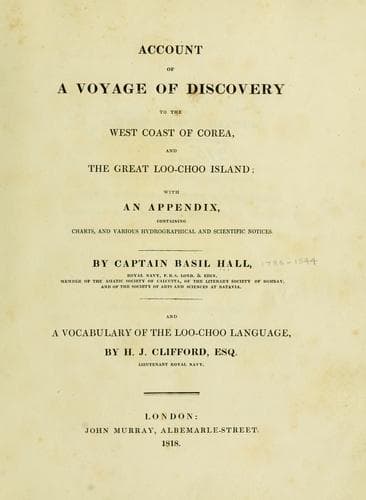
Account of a voyage of discovery to the west coast of Corea, and the great Loo-Choo IslandHall, Basil
History
Account of a voyage of discovery to the west coast of Corea, and the great Loo-Choo Island
Hall, Basil
Korea -- Description and travel; Ryukyu Islands -- Description and travel
On our entering the village we were met by a man who appeared to be the
principal person of the place; he was very polite, shewed us through the
village, and took us over his garden, where he had some sugar-cane
growing; this we admired very much, upon which he ordered one of the
finest of the canes to be taken up by the roots and presented to us; we
immediately gave him a few buttons off our jackets, with which he was
quite pleased. On its beginning to rain while we were in the garden, he
invited us into his house, which, from the walls being of wattled cane,
looked like a large basket. Rude pictures and carved wood-work figures
were hanging on the walls, together with some inscriptions in Chinese
characters.
On returning to the lower harbour of all, we went to the large village
before spoken of, which is by far the most finished of any that we have
seen on this island. The streets are regular and clean swept; each house
has a neat cane wall, as well as a screen before the door; plantain and
other trees are growing so thickly in the inside of the fence, that they
completely shade the house. Near the beach were several large houses, in
which a number of people were seated writing: on going up to them they
gave us tea and cakes, and afterwards allowed us to go over the village
without restraint; they were curious to know whether the brig was coming
into the harbour or not, and if so, how many days we meant to stay; they
expressed neither pleasure nor regret when we said that we were not
coming in. In front of the village, and parallel with the beach, there
is a splendid avenue thirty feet wide, formed by two rows of large
trees, whose branches join overhead, and effectually screen the walk
from the sun; here and there are placed wooden benches, and at some
places stone seats are fixed near the trees: this space, which is about
a quarter of a mile long, is probably used as a public walk.
A range of hills of a semicircular form embraces the village, and limits
its extent: at most places it is steep, but at the point where the north
end joins the harbour, there is an overhanging cliff about eighty feet
high, the upper part of which extends considerably beyond the base; at
eight or ten yards from the ground on this inclined face, a long
horizontal gallery has been hewn out of the solid rock: it communicates
with a number of small square excavations still deeper in the rock, for
the reception of the vases containing the bones of the dead.
Public-domain text, read in full here on John Shaqi.
Reviews
Reviews
No reviews yet
Be the first to share your thoughts on this work.
Elsewhere in the archive
Join the Discussion
Join the discussion
Sign in to leave a comment or review.
Sign InorCreate an account