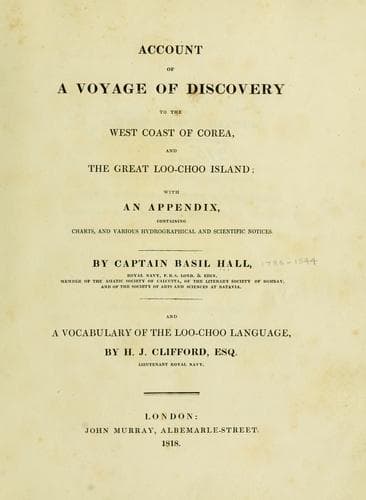
Account of a voyage of discovery to the west coast of Corea, and the great Loo-Choo IslandHall, Basil
History
Account of a voyage of discovery to the west coast of Corea, and the great Loo-Choo Island
Hall, Basil
Korea -- Description and travel; Ryukyu Islands -- Description and travel
14th of October.--During this day the whole of the east side of the
great island was explored. The north and north-east sides are high, and
destitute of cultivation; nearly in the middle, on this side, there is a
deep indenture on the coast, and the wind being such as to admit of
sailing out again, we ran in under low sail with the usual precautions;
notwithstanding which we were very nearly on the reefs, for the water
shoaled suddenly from twenty-four to eight fathoms; and although the
brig was instantly tacked, the soundings as she came round were only
five fathoms, and to leeward of us the ragged tops of a rock just level
with the surface were discovered at the distance of only fifty yards. In
exploring such places there ought to be a boat on each bow, as well as
one a-head. The coast from this bay to the south point of the island has
a belt of coral reefs at the distance of ten and fifteen miles from the
shore, and therefore cannot be approached by a ship without great
danger. The extreme south point is comparatively clear of coral; we
therefore anchored off it at sunset, proposing to land next day to
determine its position. We found the iron cables of great use when
anchoring amongst coral reefs.
15th of October.--It blew hard last night, but in the forenoon it
moderated sufficiently to allow of our landing. We ascertained the
latitude of the extreme south point with precision, and made several
other observations, all circumstances being favourable.
We had scarcely landed when the natives began to assemble in groups on
the top of the cliffs, and in a short time they came down to us, most of
them carrying long poles in their hands; we were sufficiently aware of
their inoffensive character to have no apprehension of their intentions,
otherwise their appearance would have been somewhat formidable. There
was no person of rank among them; they were communicative and full of
curiosity, which difference in manner from the inhabitants on the shores
of Port Melville may have arisen from these people knowing something of
us by reports from Napakiang, which is not above ten miles distant. It
was to be expected that we should have become a topic of discourse at
so short a distance, and probably what was said of us would be
favourable, or at all events such as would excite curiosity rather than
fear. Most of these people had fish spears tatooed on their arms in the
form of a trident, with rude barbs. When drawn on the right arm it is
called "Oodeemaw;" when on the left, "Tooga." This is the only instance
we have met with of this practice. Our curiosity was farther excited by
the appearance of these spears, from the circumstance of our never
having seen any warlike weapon on this island; but the people invariably
called them "Eeo stitchee" (fish spear). Several of the tallest of these
people were measured, but none were above five feet six inches; they
are, however, strong limbed and well proportioned. One of them wore a
Public-domain text, read in full here on John Shaqi.
Reviews
Reviews
No reviews yet
Be the first to share your thoughts on this work.
Elsewhere in the archive
Join the Discussion
Join the discussion
Sign in to leave a comment or review.
Sign InorCreate an account