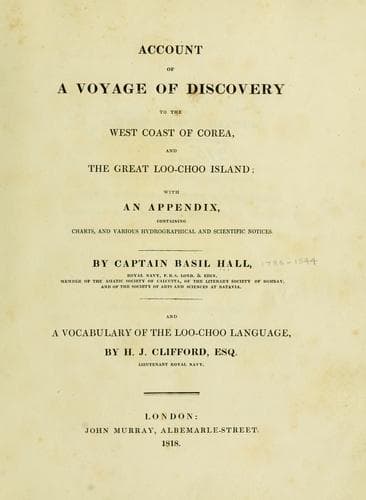
Account of a voyage of discovery to the west coast of Corea, and the great Loo-Choo IslandHall, Basil
History
Account of a voyage of discovery to the west coast of Corea, and the great Loo-Choo Island
Hall, Basil
Korea -- Description and travel; Ryukyu Islands -- Description and travel
Next day the body was carried to the grave with all the formalities
usual on such occasions, Captain Maxwell, according to custom, walking
last, with the officers and crew before him. The ready politeness of the
natives was never more strikingly displayed than now; for perceiving
that those who were of the highest rank walked in the rear, they
considered that their station must of course be in front; and they
accordingly placed themselves at the head of the procession, and
preserved throughout the ceremony the most profound silence. They were
all dressed in white robes, which we have reason to believe is their
mourning.
On the next day the natives requested leave to raise a tomb over the
grave; this was of course agreed to, and when it was completed, they
performed their own funeral service over it, by sacrificing a large hog,
and burning a quantity of spirits. Jeeroo officiated on this occasion,
and when he had done, he carried the hog to the sick in the hospital.
The chiefs also gave directions for a small square stone to be smoothed
and prepared for an epitaph; which being traced upon the stone by Mr.
Taylor, the clergyman of the Alceste, was carved very neatly by the
natives. The epitaph, after mentioning the name and age of the deceased,
stated briefly, that he and his companions in his Britannic majesty's
ships Alceste and Lyra, had been kindly treated by the inhabitants of
this island. When the purport of the writing was interpreted to the
chiefs, they appeared very much gratified at our acknowledging their
attentions.
18th of October.--Our friends expressed much pleasure on meeting us
again, particularly Jeeroo, who seems to take great interest in our
concerns: he carried us up to the sailor's tomb, where we were joined by
Ookooma, Jeema, and some of the others, who unaffectedly expressed
their sorrow for this man's untimely fate. I found my people who had
been landed previous to our sailing on the survey, much recovered, and
very grateful for the kindness of the natives. Milk, eggs, meat, and
vegetables, had been brought to them every day, and whenever they felt
disposed to walk they were accompanied by one or two of the natives, who
took their arms on coming to rough ground, and often helped them up the
steep side of the hill behind the hospital, to a pleasant grassy spot on
the summit, where the natives lighted pipes for them: in short, I
suppose sailors were never so caressed before.
Public-domain text, read in full here on John Shaqi.
Reviews
Reviews
No reviews yet
Be the first to share your thoughts on this work.
Elsewhere in the archive
Join the Discussion
Join the discussion
Sign in to leave a comment or review.
Sign InorCreate an account