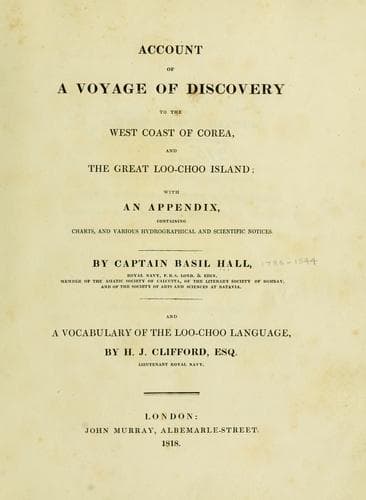
Account of a voyage of discovery to the west coast of Corea, and the great Loo-Choo IslandHall, Basil
History
Account of a voyage of discovery to the west coast of Corea, and the great Loo-Choo Island
Hall, Basil
Korea -- Description and travel; Ryukyu Islands -- Description and travel
These four bumpers made the party very merry, and it now was intimated
to them, that as all the usual formalities had been observed, they might
drink just as much as they liked, or pass the bottle altogether; a
permission of which few of them took advantage. They lighted their
pipes, laughed, joked, and seemed so happy, that it was agreed on all
hands, that conviviality is no where better understood than at Loo-choo.
After a time, at our request, they played some games, of which we had
heard them speak. The object of these games was drinking; a cup of wine
being the invariable forfeit. That every thing might be in character
during the games, some of their own little cups were put on table. One
person holds the stalk of his tobacco-pipe between the palms of his
hands, so that the pipe rolls round as he moves his hands, which he is
to hold over his head, so as not to see them. After turning it round for
a short time, he suddenly stops, and the person to whom the bowl is
directed has to drink a cup of wine. Another is a Chinese game: one
person holds his hand closed over his head, he then brings it quickly
down before him with one or more fingers extended; the person he is
playing with calls out the number of them, and if he guesses right, he
has to drink the cup of wine. These and other games caused a good deal
of noisy mirth, and at length it was proposed by them to go out, in
order to look at the sailors who were dancing on deck. Before leaving
the cabin, they shewed us a Loo-choo dance round the table: Madera
placed himself at the head before Ookooma, while the others ranged
themselves in a line behind him; he began by a song, the air of which
was very pretty, and nearly at the same time commenced the dance, which
consisted principally in throwing the body into a variety of postures,
and twisting the hands about. Sometimes the hands were placed flat
together, at others separate, but generally the former; the movements
both of the body and hands were regular and of a waving description. The
head was made to incline slowly from side to side, so as almost to
touch the shoulders; the feet were moved with a slight shuffling motion,
with an occasional long sweeping step to one side and then back again;
but the perfection of the dance appeared to be in the proper use of the
hands and body. The words of the dance song were "Sasa sangcoomah,
sangcoomee ah! sangcoomee ah! kadee yooshee daw;" when they came to the
last word they all joined in the chorus and clapped their hands.
Although Madera was the leader both in the dance and song, he was
occasionally joined in the latter by several of the others, the whole
party repeating the last word several times over. In this way they went
several times round the table. Madera had a graceful carriage, and his
dancing, though fantastic, was really elegant; his singing too was in
good taste. The others danced clumsily, though in perfect good time, and
joined with some spirit in the chorus.
Public-domain text, read in full here on John Shaqi.
Reviews
Reviews
No reviews yet
Be the first to share your thoughts on this work.
Elsewhere in the archive
Join the Discussion
Join the discussion
Sign in to leave a comment or review.
Sign InorCreate an account