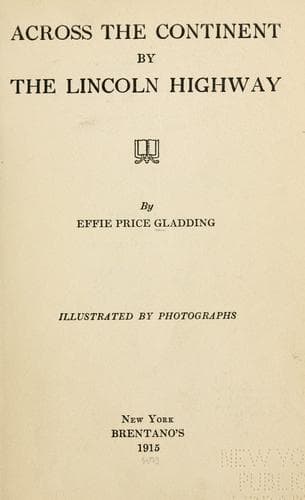
Across the Continent by the Lincoln HighwayGladding, Effie Price
General
Across the Continent by the Lincoln Highway
Gladding, Effie Price
Automobile travel; Lincoln Highway; United States -- Description and travel
Although our road is more or less indifferent, we are passing through
beautiful country. Around Keswick the fields are beautifully kept, and
the entrances to estates are marked by ivy-covered posts of yellow
stone, rough hewn. Some of the houses are red brick with white pillars,
others are of stucco. There are plenty of turkeys and chickens, and
hounds, as everywhere else in Virginia. We begin to see clumps of pine
trees from time to time. The oak trees of the forest are very large,
many of them of noble height. The juniper trees are in blossom, their
blue-green berries making them look as if they wore an exquisite
blue-green veil. In Virginia, one is everywhere impressed by the
richness and luxuriance of the foliage. All along the roadside banks are
clumps of hazel bushes, heavy with clusters of nuts in their furry green
coats. The chestnut trees are full of fruit. About a mile north of
Gordonsville we pass a plain shaft of light pinkish-grey granite on the
roadside bank at the left. The name Waddel is on the shaft and the
following inscription:
Near this spot while yet primeval forest stood the church of
the blind preacher James Waddel.
A devout man of God and a faithful minister of the
Presbyterian Church.
Born 1739--died 1805.
Socrates died like a philosopher, but Jesus Christ like a
God.
From his sermon as narrated by William Wirt.
This country has just the charm that I should expect it to have from my
reading about Virginia. Here are late-blooming honeysuckles in the
hedges. Here are men drawing wagon loads of produce along the rather
heavy clay highways to market. Sometimes they drive two horses tandem.
The rear horse is saddled, and the driver rides him and so guides the
team. Sometimes a heavy wagon is drawn by four horses, the driver
astride the near horse in the rear. Sometimes we see farmers ploughing
with three horses or mules, flocks of turkeys or chickens following in
the wake of the plough and picking up the luscious morsels thrown up by
the ploughshare. Sometimes we see fine Hereford cattle grazing in the
fields. Then come the reddest of red pigs feeding contentedly in big
fields of alfalfa. Once we pass a farmhouse with late-blooming yellow
roses climbing over the stone posts at the farm entrance. Once we see a
man ploughing in the fields with a mare, her mule baby running by her
side as she plods along. Near Madison Mills we cross the Rapidan river,
a rushing, yellow stream. As we near Culpeper the wooded country opens
out into a beautiful grazing region, the land rising and falling in long
undulations. Here and there in the great fields are clumps of trees
giving a park-like effect to the country. All this is very beautiful,
and one's joy would be undimmed were it not for the traces of the great
conflict of fifty years ago. We are coming now to the region of Cedar
Mountain which is locally known as Slaughter Mountain. Here is the site
of a bloody battle.
Public-domain text, read in full here on John Shaqi.
Reviews
Reviews
No reviews yet
Be the first to share your thoughts on this work.
Elsewhere in the archive
Join the Discussion
Join the discussion
Sign in to leave a comment or review.
Sign InorCreate an account