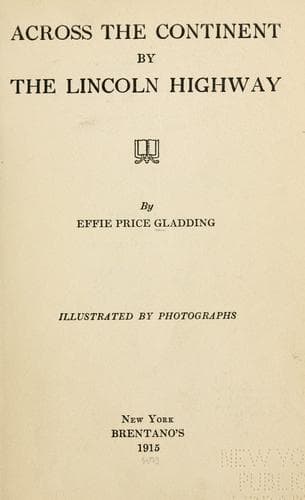
Across the Continent by the Lincoln HighwayGladding, Effie Price
General
Across the Continent by the Lincoln Highway
Gladding, Effie Price
Automobile travel; Lincoln Highway; United States -- Description and travel
We are in water-melon country and great wagon-loads of the fruit are
being taken to the nearest station for export. All along the road we see
the pink and green fragments of discarded fruit. People eat water-melons
at this season as we eat oranges in the North. We can see the remains of
many an open air banquet, by the roadside. We stop by one wagon-load and
I ask a boy who is driving what a water-melon will cost. "Oh! fifteen
cents." "We don't want such a big one," say I. "Can't you sell us a
smaller one for ten cents?" "I reckon so." And he picks out a huge
water-melon, and passes it over. As we drive along we cut out cubic
pieces of the pink delicacy. Never have we tasted such a water-melon. It
has not been wilted by a long, hot train journey, but has just come from
the field, and is fresh and delicious.
At Williamsburg we stay at the Colonial Inn, a most pleasant hostel, on
old Duke of Glouchester Street. Williamsburg, known then as Middle
Plantation, was the settlement to which the Jamestown settlers moved
when they found Jamestown Island too damp and malarial for permanent
occupancy. It is one of the most interesting Colonial towns in the
United States. In Williamsburg I realize that many of our Virginia
forefathers were Englishmen of the aristocratic class. The coats-of-arms
on the old stones in the cemetery; the quiet elegance of the old parish
church with its handsomely draped governor's pew--all the marks of early
days' ceremonial are here. A service in Bruton Parish Church is an
experience, and it is also an experience to see the communion plate of
solid silver and the old prayer-book used in Colonial days. One can see
for one's self the pages in the prayer-book where "King of kings" has
been scored out and "Ruler of the universe" has been written in on the
margin. In this prayer-book the prayer for the king has been pasted
over, a prayer for the president having been written on the paper
covering the printed prayer. The parish register of the church has many
interesting and amusing entries. In one entry twin slaves have been
registered by their master as "Adam" and "Eve."
Miss Estelle Smith, a lady who lives in a most interesting old house on
Palace Green, knows the history of Williamsburg thoroughly, and is a
very charming guide. Miss Smith's house, where a few paying guests find
gracious hospitality, is known as "Audrey House." It was this house that
Mary Johnston used as the setting for her heroine, Audrey. On one
window-pane of the "Audrey House" an unknown hand traced with a diamond
long, long ago these words: "Nov. 23rd, 1796. O fatal day." On another
pane there is a name and the date 1734. Miss Smith says that no member
of her family knows what the fatal day was, away back in 1796. No
tradition or record of that unhappiness has descended.
In Bruton church yard, I am interested to read on a family gravestone a
special inscription to "Mammy Sarah, devoted servant of the family who
died aged sixty years."
Public-domain text, read in full here on John Shaqi.
Reviews
Reviews
No reviews yet
Be the first to share your thoughts on this work.
Elsewhere in the archive
Join the Discussion
Join the discussion
Sign in to leave a comment or review.
Sign InorCreate an account