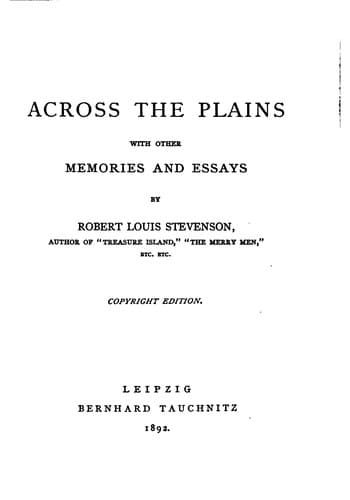
Across the Plains, with Other Memories and EssaysStevenson, Robert Louis
General
Across the Plains, with Other Memories and Essays
Stevenson, Robert Louis
Essays; Monterey (Calif.) -- Description and travel; West (U.S.) -- Description and travel
Every one lives by selling something, whatever be his right to it. The
burglar sells at the same time his own skill and courage and my silver
plate (the whole at the most moderate figure) to a Jew receiver. The
bandit sells the traveller an article of prime necessity: that
traveller’s life. And as for the old soldier, who stands for central
mark to my capricious figures of eight, he dealt in a specially; for he
was the only beggar in the world who ever gave me pleasure for my money.
He had learned a school of manners in the barracks and had the sense to
cling to it, accosting strangers with a regimental freedom, thanking
patrons with a merely regimental difference, sparing you at once the
tragedy of his position and the embarrassment of yours. There was not
one hint about him of the beggar’s emphasis, the outburst of revolting
gratitude, the rant and cant, the “God bless you, Kind, Kind gentleman,”
which insults the smallness of your alms by disproportionate vehemence,
which is so notably false, which would be so unbearable if it were true.
I am sometimes tempted to suppose this reading of the beggar’s part, a
survival of the old days when Shakespeare was intoned upon the stage and
mourners keened beside the death-bed; to think that we cannot now accept
these strong emotions unless they be uttered in the just note of life;
nor (save in the pulpit) endure these gross conventions. They wound us,
I am tempted to say, like mockery; the high voice of keening (as it yet
lingers on) strikes in the face of sorrow like a buffet; and the rant and
cant of the staled beggar stirs in us a shudder of disgust. But the fact
disproves these amateur opinions. The beggar lives by his knowledge of
the average man. He knows what he is about when he bandages his head,
and hires and drugs a babe, and poisons life with _Poor Mary Ann_ or
_Long_, _long ago_; he knows what he is about when he loads the critical
ear and sickens the nice conscience with intolerable thanks; they know
what they are about, he and his crew, when they pervade the slums of
cities, ghastly parodies of suffering, hateful parodies of gratitude.
This trade can scarce be called an imposition; it has been so blown upon
with exposures; it flaunts its fraudulence so nakedly. We pay them as we
pay those who show us, in huge exaggeration, the monsters of our
drinking-water; or those who daily predict the fall of Britain. We pay
them for the pain they inflict, pay them, and wince, and hurry on. And
truly there is nothing that can shake the conscience like a beggar’s
thanks; and that polity in which such protestations can be purchased for
a shilling, seems no scene for an honest man.
Public-domain text, read in full here on John Shaqi.
Reviews
Reviews
No reviews yet
Be the first to share your thoughts on this work.
Elsewhere in the archive
Join the Discussion
Join the discussion
Sign in to leave a comment or review.
Sign InorCreate an account