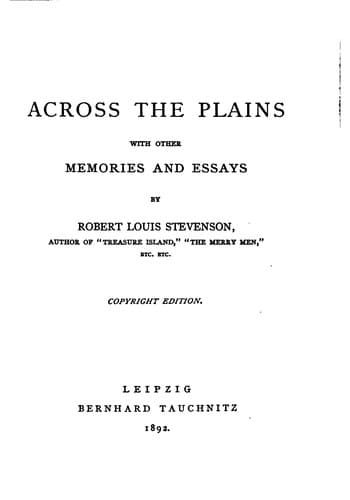
Across the Plains, with Other Memories and EssaysStevenson, Robert Louis
General
Across the Plains, with Other Memories and Essays
Stevenson, Robert Louis
Essays; Monterey (Calif.) -- Description and travel; West (U.S.) -- Description and travel
There is a pleasant tale of some worthless, phrasing Frenchman, who was
taxed with ingratitude: “_Il faut savoir garder l’indépendance du cœur_,”
cried he. I own I feel with him. Gratitude without familarity,
gratitude otherwise than as a nameless element in a friendship, is a
thing so near to hatred that I do not care to split the difference.
Until I find a man who is pleased to receive obligations, I shall
continue to question the tact of those who are eager to confer them.
What an art it is, to give, even to our nearest friends! and what a test
of manners, to receive! How, upon either side, we smuggle away the
obligation, blushing for each other; how bluff and dull we make the
giver; how hasty, how falsely cheerful, the receiver! And yet an act of
such difficulty and distress between near friends, it is supposed we can
perform to a total stranger and leave the man transfixed with grateful
emotions. The last thing you can do to a man is to burthen him with an
obligation, and it is what we propose to begin with! But let us not be
deceived: unless he is totally degraded to his trade, anger jars in his
inside, and he grates his teeth at our gratuity.
We should wipe two words from our vocabulary: gratitude and charity. In
real life, help is given out of friendship, or it is not valued; it is
received from the hand of friendship, or it is resented. We are all too
proud to take a naked gift: we must seem to pay it, if in nothing else,
then with the delights of our society. Here, then, is the pitiful fix of
the rich man; here is that needle’s eye in which he stuck already in the
days of Christ, and still sticks to-day, firmer, if possible, than ever:
that he has the money and lacks the love which should make his money
acceptable. Here and now, just as of old in Palestine, he has the rich
to dinner, it is with the rich that he takes his pleasure: and when his
turn comes to be charitable, he looks in vain for a recipient. His
friends are not poor, they do not want; the poor are not his friends,
they will not take. To whom is he to give? Where to find—note this
phase—the Deserving Poor? Charity is (what they call) centralised;
offices are hired; societies founded, with secretaries paid or unpaid:
the hunt of the Deserving Poor goes merrily forward. I think it will
take more than a merely human secretary to disinter that character.
What! a class that is to be in want from no fault of its own, and yet
greedily eager to receive from strangers; and to be quite respectable,
and at the same time quite devoid of self-respect; and play the most
delicate part of friendship, and yet never be seen; and wear the form of
man, and yet fly in the face of all the laws of human nature:—and all
this, in the hope of getting a belly-god Burgess through a needle’s eye!
O, let him stick, by all means: and let his polity tumble in the dust;
and let his epitaph and all his literature (of which my own works begin
Public-domain text, read in full here on John Shaqi.
Reviews
Reviews
No reviews yet
Be the first to share your thoughts on this work.
Elsewhere in the archive
Join the Discussion
Join the discussion
Sign in to leave a comment or review.
Sign InorCreate an account