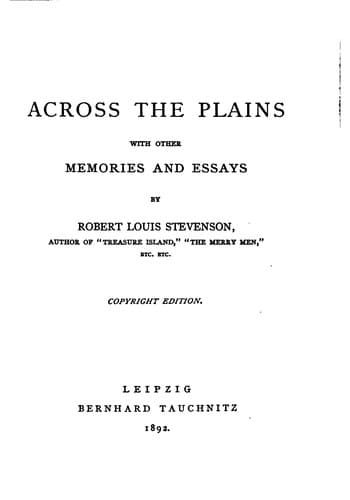
Across the Plains, with Other Memories and EssaysStevenson, Robert Louis
General
Across the Plains, with Other Memories and Essays
Stevenson, Robert Louis
Essays; Monterey (Calif.) -- Description and travel; West (U.S.) -- Description and travel
What a monstrous spectre is this man, the disease of the agglutinated
dust, lifting alternate feet or lying drugged with slumber; killing,
feeding, growing, bringing forth small copies of himself; grown upon with
hair like grass, fitted with eyes that move and glitter in his face; a
thing to set children screaming;—and yet looked at nearlier, known as his
fellows know him, how surprising are his attributes! Poor soul, here for
so little, cast among so many hardships, filled with desires so
incommensurate and so inconsistent, savagely surrounded, savagely
descended, irremediably condemned to prey upon his fellow lives: who
should have blamed him had he been of a piece with his destiny and a
being merely barbarous? And we look and behold him instead filled with
imperfect virtues: infinitely childish, often admirably valiant, often
touchingly kind; sitting down, amidst his momentary life, to debate of
right and wrong and the attributes of the deity; rising up to do battle
for an egg or die for an idea; singling out his friends and his mate with
cordial affection; bringing forth in pain, rearing with long-suffering
solicitude, his young. To touch the heart of his mystery, we find, in
him one thought, strange to the point of lunacy: the thought of duty; the
thought of something owing to himself, to his neighbour, to his God: an
ideal of decency, to which he would rise if it were possible; a limit of
shame, below which, if it be possible, he will not stoop. The design in
most men is one of conformity; here and there, in picked natures, it
transcends itself and soars on the other side, arming martyrs with
independence; but in all, in their degrees, it is a bosom thought:—Not in
man alone, for we trace it in dogs and cats whom we know fairly well, and
doubtless some similar point of honour sways the elephant, the oyster,
and the louse, of whom we know so little:—But in man, at least, it sways
with so complete an empire that merely selfish things come second, even
with the selfish: that appetites are starved, fears are conquered, pains
supported; that almost the dullest shrinks from the reproof of a glance,
although it were a child’s; and all but the most cowardly stand amid the
risks of war; and the more noble, having strongly conceived an act as due
to their ideal, affront and embrace death. Strange enough if, with their
singular origin and perverted practice, they think they are to be
rewarded in some future life: stranger still, if they are persuaded of
the contrary, and think this blow, which they solicit, will strike them
senseless for eternity. I shall be reminded what a tragedy of
misconception and misconduct man at large presents: of organised
injustice, cowardly violence and treacherous crime; and of the damning
imperfections of the best. They cannot be too darkly drawn. Man is
indeed marked for failure in his efforts to do right. But where the best
consistently miscarry, how tenfold more remarkable that all should
Public-domain text, read in full here on John Shaqi.
Reviews
Reviews
No reviews yet
Be the first to share your thoughts on this work.
Elsewhere in the archive
Join the Discussion
Join the discussion
Sign in to leave a comment or review.
Sign InorCreate an account