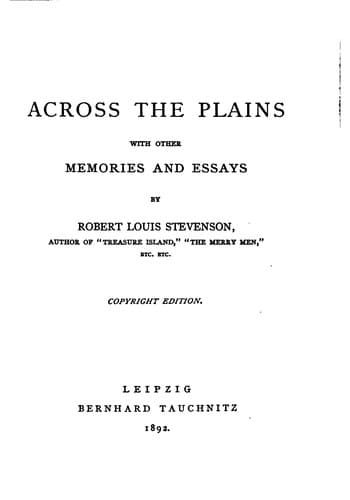
Across the Plains, with Other Memories and EssaysStevenson, Robert Louis
General
Across the Plains, with Other Memories and Essays
Stevenson, Robert Louis
Essays; Monterey (Calif.) -- Description and travel; West (U.S.) -- Description and travel
And as we dwell, we living things, in our isle of terror and under the
imminent hand of death, God forbid it should be man the erected, the
reasoner, the wise in his own eyes—God forbid it should be man that
wearies in well-doing, that despairs of unrewarded effort, or utters the
language of complaint. Let it be enough for faith, that the whole
creation groans in mortal frailty, strives with unconquerable constancy:
Surely not all in vain.
XII
A CHRISTMAS SERMON
BY the time this paper appears, I shall have been talking for twelve
months; {202} and it is thought I should take my leave in a formal and
seasonable manner. Valedictory eloquence is rare, and death-bed sayings
have not often hit the mark of the occasion. Charles Second, wit and
sceptic, a man whose life had been one long lesson in human incredulity,
an easy-going comrade, a manoeuvring king—remembered and embodied all his
wit and scepticism along with more than his usual good humour in the
famous “I am afraid, gentlemen, I am an unconscionable time a-dying.”
I
An unconscionable time a-dying—there is the picture (“I am afraid,
gentlemen,”) of your life and of mine. The sands run out, and the hours
are “numbered and imputed,” and the days go by; and when the last of
these finds us, we have been a long time dying, and what else? The very
length is something, if we reach that hour of separation undishonoured;
and to have lived at all is doubtless (in the soldierly expression) to
have served. There is a tale in Ticitus of how the veterans mutinied in
the German wilderness; of how they mobbed Germanicus, clamouing go home;
and of how, seizing their general’s hand, these old, war-worn exiles
passed his finger along their toothless gums. _Sunt lacrymæ rerum_: this
was the most eloquent of the songs of Simeon. And when a man has lived
to a fair age, he bears his marks of service. He may have never been
remarked upon the breach at the head of the army; at least he shall have
lost his teeth on the camp bread.
The idealism of serious people in this age of ours is of a noble
character. It never seems to them that they have served enough; they
have a fine impatience of their virtues. It were perhaps more modest to
be singly thankful that we are no worse. It is not only our enemies,
those desperate characters—it is we ourselves who know not what we
do,—thence springs the glimmering hope that perhaps we do better than we
think: that to scramble through this random business with hands
reasonably clean to have played the part of a man or woman with some
reasonable fulness, to have often resisted the diabolic, and at the end
to be still resisting it, is for the poor human soldier to have done
right well. To ask to see some fruit of our endeavour is but a
transcendental way of serving for reward; and what we take to be contempt
of self is only greed of hire.
Public-domain text, read in full here on John Shaqi.
Reviews
Reviews
No reviews yet
Be the first to share your thoughts on this work.
Elsewhere in the archive
Join the Discussion
Join the discussion
Sign in to leave a comment or review.
Sign InorCreate an account