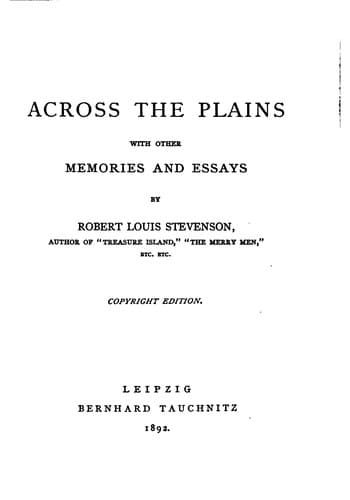
Across the Plains, with Other Memories and EssaysStevenson, Robert Louis
General
Across the Plains, with Other Memories and Essays
Stevenson, Robert Louis
Essays; Monterey (Calif.) -- Description and travel; West (U.S.) -- Description and travel
And yet the forest has been civilised throughout. The most savage
corners bear a name, and have been cherished like antiquities; in the
most remote, Nature has prepared and balanced her effects as if with
conscious art; and man, with his guiding arrows of blue paint, has
countersigned the picture. After your farthest wandering, you are never
surprised to come forth upon the vast avenue of highway, to strike the
centre point of branching alleys, or to find the aqueduct trailing,
thousand-footed, through the brush. It is not a wilderness; it is rather
a preserve. And, fitly enough, the centre of the maze is not a hermit’s
cavern. In the midst, a little mirthful town lies sunlit, humming with
the business of pleasure; and the palace, breathing distinction and
peopled by historic names, stands smokeless among gardens.
Perhaps the last attempt at savage life was that of the harmless humbug
who called himself the hermit. In a great tree, close by the highroad,
he had built himself a little cabin after the manner of the Swiss Family
Robinson; thither he mounted at night, by the romantic aid of a rope
ladder; and if dirt be any proof of sincerity, the man was savage as a
Sioux. I had the pleasure of his acquaintance; he appeared grossly
stupid, not in his perfect wits, and interested in nothing but small
change; for that he had a great avidity. In the course of time he proved
to be a chicken-stealer, and vanished from his perch; and perhaps from
the first he was no true votary of forest freedom, but an ingenious,
theatrically-minded beggar, and his cabin in the tree was only
stock-in-trade to beg withal. The choice of his position would seem to
indicate so much; for if in the forest there are no places still to be
discovered, there are many that have been forgotten, and that lie
unvisited. There, to be sure, are the blue arrows waiting to reconduct
you, now blazed upon a tree, now posted in the corner of a rock. But
your security from interruption is complete; you might camp for weeks, if
there were only water, and not a soul suspect your presence; and if I may
suppose the reader to have committed some great crime and come to me for
aid, I think I could still find my way to a small cavern, fitted with a
hearth and chimney, where he might lie perfectly concealed. A
confederate landscape-painter might daily supply him with food; for
water, he would have to make a nightly tramp as far as to the nearest
pond; and at last, when the hue and cry began to blow over, he might get
gently on the train at some side station, work round by a series of
junctions, and be quietly captured at the frontier.
Public-domain text, read in full here on John Shaqi.
Reviews
Reviews
No reviews yet
Be the first to share your thoughts on this work.
Elsewhere in the archive
Join the Discussion
Join the discussion
Sign in to leave a comment or review.
Sign InorCreate an account