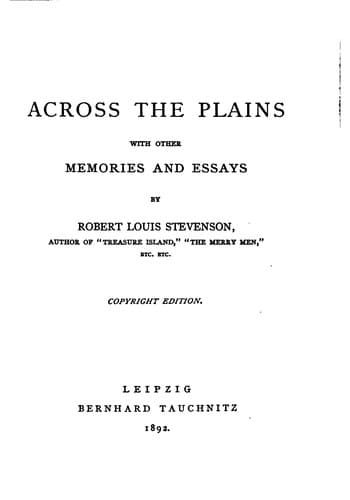
Across the Plains, with Other Memories and EssaysStevenson, Robert Louis
General
Across the Plains, with Other Memories and Essays
Stevenson, Robert Louis
Essays; Monterey (Calif.) -- Description and travel; West (U.S.) -- Description and travel
Thus Fontainebleau, although it is truly but a pleasure-ground, and
although, in favourable weather, and in the more celebrated quarters, it
literally buzzes with the tourist, yet has some of the immunities and
offers some of the repose of natural forests. And the solitary, although
he must return at night to his frequented inn, may yet pass the day with
his own thoughts in the companionable silence of the trees. The demands
of the imagination vary; some can be alone in a back garden looked upon
by windows; others, like the ostrich, are content with a solitude that
meets the eye; and others, again, expand in fancy to the very borders of
their desert, and are irritably conscious of a hunter’s camp in an
adjacent county. To these last, of course, Fontainebleau will seem but
an extended tea-garden: a Rosherville on a by-day. But to the plain man
it offers solitude: an excellent thing in itself, and a good whet for
company.
III
I was for some time a consistent Barbizonian; _et ego in Arcadia vixi_,
it was a pleasant season; and that noiseless hamlet lying close among the
borders of the wood is for me, as for so many others, a green spot in
memory. The great Millet was just dead, the green shutters of his modest
house were closed; his daughters were in mourning. The date of my first
visit was thus an epoch in the history of art: in a lesser way, it was an
epoch in the history of the Latin Quarter. The _Petit Cénacle_ was dead
and buried; Murger and his crew of sponging vagabonds were all at rest
from their expedients; the tradition of their real life was nearly lost;
and the petrified legend of the _Vie de Bohéme_ had become a sort of
gospel, and still gave the cue to zealous imitators. But if the book be
written in rose-water, the imitation was still farther expurgated;
honesty was the rule; the innkeepers gave, as I have said, almost
unlimited credit; they suffered the seediest painter to depart, to take
all his belongings, and to leave his bill unpaid; and if they sometimes
lost, it was by English and Americans alone. At the same time, the great
influx of Anglo-Saxons had begun to affect the life of the studious.
There had been disputes; and, in one instance at least, the English and
the Americans had made common cause to prevent a cruel pleasantry. It
would be well if nations and races could communicate their qualities; but
in practice when they look upon each other, they have an eye to nothing
but defects. The Anglo-Saxon is essentially dishonest; the French is
devoid by nature of the principle that we call “Fair Play.” The
Frenchman marvelled at the scruples of his guest, and, when that defender
of innocence retired over-seas and left his bills unpaid, he marvelled
once again; the good and evil were, in his eyes, part and parcel of the
same eccentricity; a shrug expressed his judgment upon both.
Public-domain text, read in full here on John Shaqi.
Reviews
Reviews
No reviews yet
Be the first to share your thoughts on this work.
Elsewhere in the archive
Join the Discussion
Join the discussion
Sign in to leave a comment or review.
Sign InorCreate an account