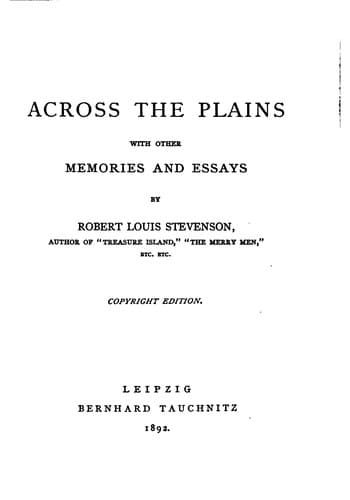
Across the Plains, with Other Memories and EssaysStevenson, Robert Louis
General
Across the Plains, with Other Memories and Essays
Stevenson, Robert Louis
Essays; Monterey (Calif.) -- Description and travel; West (U.S.) -- Description and travel
At Barbizon there was no master, no pontiff in the arts. Palizzi bore
rule at Gretz—urbane, superior rule—his memory rich in anecdotes of the
great men of yore, his mind fertile in theories; sceptical, composed, and
venerable to the eye; and yet beneath these outworks, all twittering with
Italian superstition, his eye scouting for omens, and the whole fabric of
his manners giving way on the appearance of a hunchback. Cernay had
Pelouse, the admirable, placid Pelouse, smilingly critical of youth, who,
when a full-blown commercial traveller, suddenly threw down his samples,
bought a colour-box, and became the master whom we have all admired.
Marlotte, for a central figure, boasted Olivier de Penne. Only Barbizon,
since the death of Millet, was a headless commonwealth. Even its
secondary lights, and those who in my day made the stranger welcome, have
since deserted it. The good Lachèvre has departed, carrying his
household gods; and long before that Gaston Lafenestre was taken from our
midst by an untimely death. He died before he had deserved success; it
may be, he would never have deserved it; but his kind, comely, modest
countenance still haunts the memory of all who knew him. Another—whom I
will not name—has moved farther on, pursuing the strange Odyssey of his
decadence. His days of royal favour had departed even then; but he still
retained, in his narrower life at Barbizon, a certain stamp of conscious
importance, hearty, friendly, filling the room, the occupant of several
chairs; nor had he yet ceased his losing battle, still labouring upon
great canvases that none would buy, still waiting the return of fortune.
But these days also were too good to last; and the former favourite of
two sovereigns fled, if I heard the truth, by night. There was a time
when he was counted a great man, and Millet but a dauber; behold, how the
whirligig of time brings in his revenges! To pity Millet is a piece of
arrogance; if life be hard for such resolute and pious spirits, it is
harder still for us, had we the wit to understand it; but we may pity his
unhappier rival, who, for no apparent merit, was raised to opulence and
momentary fame, and, through no apparent fault was suffered step by step
to sink again to nothing. No misfortune can exceed the bitterness of
such back-foremost progress, even bravely supported as it was; but to
those also who were taken early from the easel, a regret is due. From
all the young men of this period, one stood out by the vigour of his
promise; he was in the age of fermentation, enamoured of eccentricities.
“Il faut faire de la peinture nouvelle,” was his watchword; but if time
and experience had continued his education, if he had been granted health
to return from these excursions to the steady and the central, I must
believe that the name of Hills had become famous.
Public-domain text, read in full here on John Shaqi.
Reviews
Reviews
No reviews yet
Be the first to share your thoughts on this work.
Elsewhere in the archive
Join the Discussion
Join the discussion
Sign in to leave a comment or review.
Sign InorCreate an account