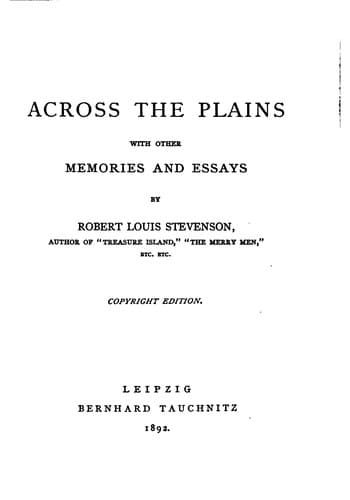
Across the Plains, with Other Memories and EssaysStevenson, Robert Louis
General
Across the Plains, with Other Memories and Essays
Stevenson, Robert Louis
Essays; Monterey (Calif.) -- Description and travel; West (U.S.) -- Description and travel
there was some misunderstanding, highly possible that the Commissary
(charmed with his visitor) supposed the attraction to be mutual and took
for an act of growing friendship what the Cigarette himself regarded as a
bribe. And at any rate, was there ever a bribe more singular than an odd
volume of Michelet’s history? The work was promised him for the morrow,
before our departure; and presently after, either because he had his
price, or to show that he was not the man to be behind in friendly
offices—“_Eh bien_,” he said, “_je suppose qu’il faut lâher voire
camarade_.” And he tore up that feast of humour, the unfinished
_procès-verbal_. Ah, if he had only torn up instead the Arethusa’s
roundels! There were many works burnt at Alexandria, there are many
treasured in the British Museum, that I could better spare than the
_procès-verbal_ of Châtillon. Poor bubuckled Commissary! I begin to be
sorry that he never had his Michelet: perceiving in him fine human
traits, a broad-based stupidity, a gusto in his magisterial functions, a
taste for letters, a ready admiration for the admirable. And if he did
not admire the Arethusa, he was not alone in that.
To the imprisoned one, shivering under the public covering, there came
suddenly a noise of bolts and chains. He sprang to his feet, ready to
welcome a companion in calamity; and instead of that, the door was flung
wide, the friendly gendarme appeared above in the strong daylight, and
with a magnificent gesture (being probably a student of the drama)—“_Vous
êtes libre_!” he said. None too soon for the Arethusa. I doubt if he
had been half-an-hour imprisoned; but by the watch in a man’s brain
(which was the only watch he carried) he should have been eight times
longer; and he passed forth with ecstasy up the cellar stairs into the
healing warmth of the afternoon sun; and the breath of the earth came as
sweet as a cow’s into his nostril; and he heard again (and could have
laughed for pleasure) the concord of delicate noises that we call the hum
of life.
Public-domain text, read in full here on John Shaqi.
Reviews
Reviews
No reviews yet
Be the first to share your thoughts on this work.
Elsewhere in the archive
Join the Discussion
Join the discussion
Sign in to leave a comment or review.
Sign InorCreate an account