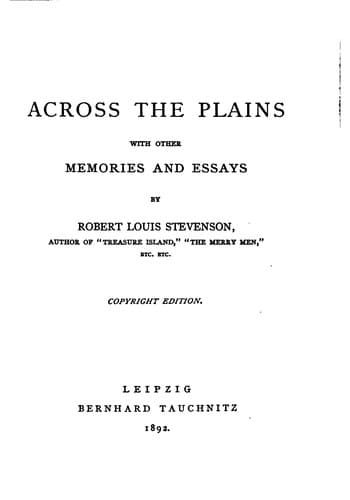
Across the Plains, with Other Memories and EssaysStevenson, Robert Louis
General
Across the Plains, with Other Memories and Essays
Stevenson, Robert Louis
Essays; Monterey (Calif.) -- Description and travel; West (U.S.) -- Description and travel
woody hillside garden—a look of such a piercing sadness that my heart
died; and seating myself on a door-step, I shed tears of miserable
sympathy. A benevolent cat cumbered me the while with consolations—we
two were alone in all that was visible of the London Road: two poor waifs
who had each tasted sorrow—and she fawned upon the weeper, and gambolled
for his entertainment, watching the effect it seemed, with motherly eyes.
For the sake of the cat, God bless her! I confessed at home the story of
my weakness; and so it comes about that I owed a certain journey, and the
reader owes the present paper, to a cat in the London Road. It was
judged, if I had thus brimmed over on the public highway, some change of
scene was (in the medical sense) indicated; my father at the time was
visiting the harbour lights of Scotland; and it was decided he should
take me along with him around a portion of the shores of Fife; my first
professional tour, my first journey in the complete character of man,
without the help of petticoats.
The Kingdom of Fife (that royal province) may be observed by the curious
on the map, occupying a tongue of land between the firths of Forth and
Tay. It may be continually seen from many parts of Edinburgh (among the
rest, from the windows of my father’s house) dying away into the distance
and the easterly _haar_ with one smoky seaside town beyond another, or in
winter printing on the gray heaven some glittering hill-tops. It has no
beauty to recommend it, being a low, sea-salted, wind-vexed promontory;
trees very rare, except (as common on the east coast) along the dens of
rivers; the fields well cultivated, I understand, but not lovely to the
eye. It is of the coast I speak: the interior may be the garden of Eden.
History broods over that part of the world like the easterly _haar_.
Even on the map, its long row of Gaelic place-names bear testimony to an
old and settled race. Of these little towns, posted along the shore as
close as sedges, each with its bit of harbour, its old weather-beaten
church or public building, its flavour of decayed prosperity and decaying
fish, not one but has its legend, quaint or tragic: Dunfermline, in whose
royal towers the king may be still observed (in the ballad) drinking the
blood-red wine; somnolent Inverkeithing, once the quarantine of Leith;
Aberdour, hard by the monastic islet of Inchcolm, hard by Donibristle
where the “bonny face was spoiled”; Burntisland where, when Paul Jones
was off the coast, the Reverend Mr. Shirra had a table carried between
tidemarks, and publicly prayed against the rover at the pitch of his
voice and his broad lowland dialect; Kinghorn, where Alexander “brak’s
neckbane” and left Scotland to the English wars; Kirkcaldy, where the
witches once prevailed extremely and sank tall ships and honest mariners
in the North Sea; Dysart, famous—well famous at least to me for the Dutch
ships that lay in its harbour, painted like toys and with pots of flowers
Public-domain text, read in full here on John Shaqi.
Reviews
Reviews
No reviews yet
Be the first to share your thoughts on this work.
Elsewhere in the archive
Join the Discussion
Join the discussion
Sign in to leave a comment or review.
Sign InorCreate an account