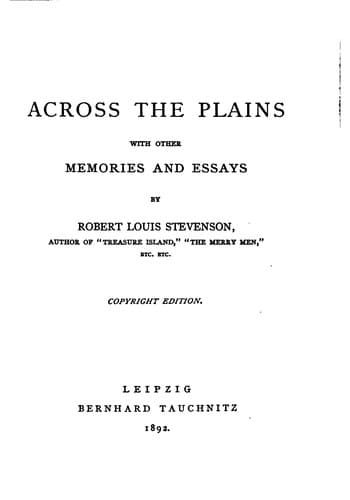
Across the Plains, with Other Memories and EssaysStevenson, Robert Louis
General
Across the Plains, with Other Memories and Essays
Stevenson, Robert Louis
Essays; Monterey (Calif.) -- Description and travel; West (U.S.) -- Description and travel
Wick was scarce an eligible place of stay. But how much better it was to
hang in the cold wind upon the pier, to go down with Bob Bain among the
roots of the staging, to be all day in a boat coiling a wet rope and
shouting orders—not always very wise—than to be warm and dry, and dull,
and dead-alive, in the most comfortable office. And Wick itself had in
those days a note of originality. It may have still, but I misdoubt it
much. The old minister of Keiss would not preach, in these degenerate
times, for an hour and a half upon the clock. The gipsies must be gone
from their cavern; where you might see, from the mouth, the women tending
their fire, like Meg Merrilies, and the men sleeping off their coarse
potations; and where, in winter gales, the surf would beleaguer them
closely, bursting in their very door. A traveller to-day upon the Thurso
coach would scarce observe a little cloud of smoke among the moorlands,
and be told, quite openly, it marked a private still. He would not
indeed make that journey, for there is now no Thurso coach. And even if
he could, one little thing that happened to me could never happen to him,
or not with the same trenchancy of contrast.
We had been upon the road all evening; the coach-top was crowded with
Lews fishers going home, scarce anything but Gaelic had sounded in my
ears; and our way had lain throughout over a moorish country very
northern to behold. Latish at night, though it was still broad day in
our subarctic latitude, we came down upon the shores of the roaring
Pentland Firth, that grave of mariners; on one hand, the cliffs of Dunnet
Head ran seaward; in front was the little bare, white town of Castleton,
its streets full of blowing sand; nothing beyond, but the North Islands,
the great deep, and the perennial ice-fields of the Pole. And here, in
the last imaginable place, there sprang up young outlandish voices and a
chatter of some foreign speech; and I saw, pursuing the coach with its
load of Hebridean fishers—as they had pursued _vetturini_ up the passes
of the Apennines or perhaps along the grotto under Virgil’s tomb—two
little dark-eyed, white-toothed Italian vagabonds, of twelve to fourteen
years of age, one with a hurdy-gurdy, the other with a cage of white
mice. The coach passed on, and their small Italian chatter died in the
distance; and I was left to marvel how they had wandered into that
country, and how they fared in it, and what they thought of it, and when
(if ever) they should see again the silver wind-breaks run among the
olives, and the stone-pine stand guard upon Etruscan sepulchres.
Public-domain text, read in full here on John Shaqi.
Reviews
Reviews
No reviews yet
Be the first to share your thoughts on this work.
Elsewhere in the archive
Join the Discussion
Join the discussion
Sign in to leave a comment or review.
Sign InorCreate an account