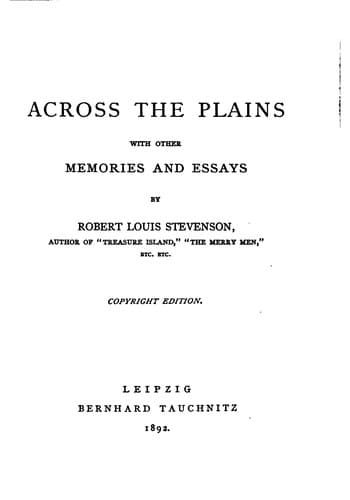
Across the Plains, with Other Memories and EssaysStevenson, Robert Louis
General
Across the Plains, with Other Memories and Essays
Stevenson, Robert Louis
Essays; Monterey (Calif.) -- Description and travel; West (U.S.) -- Description and travel
It would be hard to pick out a career more cheerless than that of Dancer,
the miser, as he figures in the “Old Bailey Reports,” a prey to the most
sordid persecutions, the butt of his neighbourhood, betrayed by his hired
man, his house beleaguered by the impish schoolboy, and he himself
grinding and fuming and impotently fleeing to the law against these
pin-pricks. You marvel at first that any one should willingly prolong a
life so destitute of charm and dignity; and then you call to memory that
had he chosen, had he ceased to be a miser, he could have been freed at
once from these trials, and might have built himself a castle and gone
escorted by a squadron. For the love of more recondite joys, which we
cannot estimate, which, it may be, we should envy, the man had willingly
forgone both comfort and consideration. “His mind to him a kingdom was”;
and sure enough, digging into that mind, which seems at first a
dust-heap, we unearth some priceless jewels. For Dancer must have had
the love of power and the disdain of using it, a noble character in
itself; disdain of many pleasures, a chief part of what is commonly
called wisdom; disdain of the inevitable end, that finest trait of
mankind; scorn of men’s opinions, another element of virtue; and at the
back of all, a conscience just like yours and mine, whining like a cur,
swindling like a thimble-rigger, but still pointing (there or
there-about) to some conventional standard. Here were a cabinet portrait
to which Hawthorne perhaps had done justice; and yet not Hawthorne
either, for he was mildly minded, and it lay not in him to create for us
that throb of the miser’s pulse, his fretful energy of gusto, his vast
arms of ambition clutching in he knows not what: insatiable, insane, a
god with a muck-rake. Thus, at least, looking in the bosom of the miser,
consideration detects the poet in the full tide of life, with more,
indeed, of the poetic fire than usually goes to epics; and tracing that
mean man about his cold hearth, and to and fro in his discomfortable
house, spies within him a blazing bonfire of delight. And so with
others, who do not live by bread alone, but by some cherished and perhaps
fantastic pleasure; who are meat salesmen to the external eye, and
possibly to themselves are Shakespeares, Napoleons, or Beethovens; who
have not one virtue to rub against another in the field of active life,
and yet perhaps, in the life of contemplation, sit with the saints. We
see them on the street, and we can count their buttons; but heaven knows
in what they pride themselves! heaven knows where they have set their
treasure!
Public-domain text, read in full here on John Shaqi.
Reviews
Reviews
No reviews yet
Be the first to share your thoughts on this work.
Elsewhere in the archive
Join the Discussion
Join the discussion
Sign in to leave a comment or review.
Sign InorCreate an account