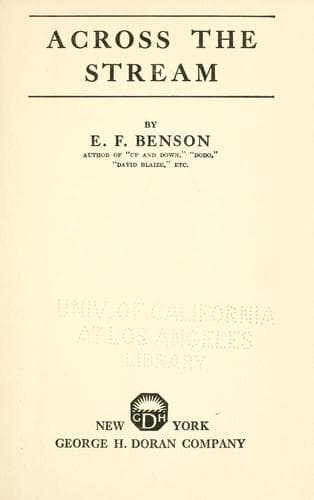
England -- Social life and customs -- 20th century -- Fiction; Spiritualism -- Fiction
But Helena, as she finished her breakfast, recalled her mind from these
shining experiences, except in so far as they bore on the theme that
insistently occupied her. There was no doubt, especially after that
quiet talk in the paved garden outside the ball-room last night, that
Bertie Harlow was dazzled, according to plan. Heaven only knew when he
had last been to a ball, for he was close on forty (Helena had naturally
looked him up in a Peerage, since she liked to know about her friends),
and she felt pretty certain that he had danced with no one but her. You
could perhaps hardly call his share of the performance dancing; he had
"stepped a measure," and twice trodden on her toe; but, after all, it
did not matter whether your husband danced or not, since naturally, when
those relations had been arrived at, he would not dance with you. Many
women no doubt, when they were married, would think it an advantage that
their husbands did not dance, since then they would not dance with
anybody else. But it was not in Helena's nature prospectively to grudge
him such amusements, should he desire them, when once she had got him.
But she had to get him first, and to do that she had to keep him
dazzled. He must not get accustomed to her.
Helena had a very strong belief in the desirability of simplifying life.
This did not in the least imply that she thought there was anything
attractive in the simple life: her simplification amounted to this, that
she formulated exactly what she wanted, and then without deflection of
aim did the very best with her efficient armoury of weapons to get it;
while the second clause in the simplification of life was to find out
what irritated or bored you, and with all your power eliminate it from
your existence. If you could not get what you wanted without getting
something that bored you, it was merely necessary to ascertain how the
balance between these conflicting interests lay. As practically applied
to the case in hand, she was aware that Lord Harlow bored her, though
not badly, and that his nose irritated her. That she would almost
certainly get used to, while on the other side of the scale were
quantities of things she liked. She liked immense wealth, position, and
the liberty she would undoubtedly enjoy if she married this amiable man,
whom so many had tried to capture. That in itself was an incentive to
her pride, and, without being a snob, she saw no objection to being a
Marchioness.
Public-domain text, read in full here on John Shaqi.
Reviews
Reviews
No reviews yet
Be the first to share your thoughts on this work.
Elsewhere in the archive
Join the Discussion
Join the discussion
Sign in to leave a comment or review.
Sign InorCreate an account