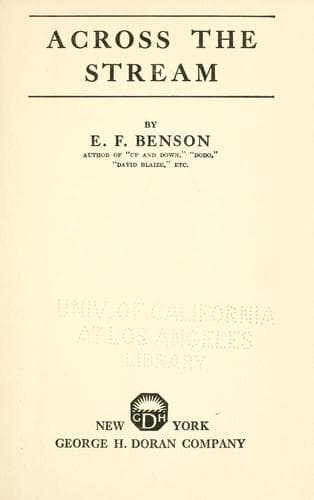
England -- Social life and customs -- 20th century -- Fiction; Spiritualism -- Fiction
Lord Tintagel finished his cocktail and put the glass down.
"To be sure; that was it," he said. "It's time we took ourselves in
hand. Your grandfather gave me a warning, and I wish to God I had taken
it. But we'll help each other--eh, Archie? That will make it easier for
both of us."
"I don't care a toss whether I take alcohol or not," said Archie. "As
you remarked last night, father, I hardly touched it till a month ago."
Lord Tintagel laughed.
"But you've shown remarkable aptitude for it since," he said. "You found
no difficulty at all in getting the hang of the thing."
Faintly, like a lost echo, there entered into Archie's mind the inherent
horror of such an interview between father and son. But it was drowned
by the inward laughter with which the scene inspired him, and his
spirit, whatever it was that watched the play, looked on as from some
curtained box, where, unseen, it could giggle at unseemliness, at some
uncensored farce. Last night the same thing had amused him, but then he
was in that contented oblivion of his troubles which alcohol lent him,
whereas now it was morning and the time when he was least likely to take
any but the most bitter and savage view of a situation. But all morning
he had been possessed by the sunny lightness of heart with which
Martin's communication of last night had inspired him. He must be
patient, disperse and blow away by the great winds of love the hatred
and intolerance that had been obscuring his soul. And surely it was not
only for Helena that he must feel that nobler impulse: all that touched
his daily life must be treated with the same manly tenderness. Nothing
must shock him, nothing must irritate him, for such emotions were narrow
and limited, incompatible with the oceanic quality of love. All this
seemed directly inspired by Martin, who had brought him the first ray of
true illumination. And yet, while he sunned himself in the light, there
was something that apparently belonged to his bitter, his disappointed
self that cried out for recognition, insisting that these dreams of love
and tolerance were of a fibre infinitely coarser than its own rebellious
attitude. It strove and cried, and the smooth edification of Martin's
voice silenced it again.
Public-domain text, read in full here on John Shaqi.
Reviews
Reviews
No reviews yet
Be the first to share your thoughts on this work.
Elsewhere in the archive
Join the Discussion
Join the discussion
Sign in to leave a comment or review.
Sign InorCreate an account