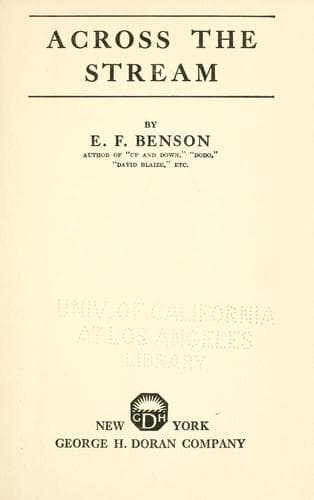
England -- Social life and customs -- 20th century -- Fiction; Spiritualism -- Fiction
Since then, up to the day when he was now expecting her entry for the
third act, he had thought over the whole situation with the imaginative
vision which absinthe inspired. He had not the slightest doubt in his
mind that Helena, according to her capacity for loving, was in love with
him, and that she thought he was still in love with her. But, when he
considered it all, he found he had no longer the slightest intention of
marrying her, even though she had L15,000 a year for life without
conditions attached. Plenty of money was no doubt a preventive of
discomfort in this life, and he felt it was fine of him not to be
attracted by so ignoble a bait. But no amount of money would really
compensate for the inseparable companionship of Helena, with her
foolishness, her apparent inability to understand that her
insincerities, so far from being convincing and beautiful, were no more
than the most puerile and transparent counterfeits. Certainly she
aroused the ardour of his senses, but how long would that last? And,
even while it lasted, how could it compare with his ardour for his
absinthe-coloured dreams, and the ecstasy of his communion with the
spirit that had made its home in him? She would interrupt all that; and,
as a companion, she could not compare with his father. She would always
be wanting to be caressed and made much of and admired and taken care
of. It would soon become most horribly tedious.
There was a further reason against marrying her, which was as potent as
any. He would forfeit his revenge on her, if he did that. Once, dim ages
ago, it seemed, and on another plane of existence, he had loved her, and
she, knowing it, had fed his devotion with smiles and glances, and at
the end had chosen him whose body now decayed in some graveyard of North
France, already probably desecrated by the on-swarming Germans. Now it
was Archie's turn; already, he was sure, she expected to marry him, and
she would learn that he had not the least intention of doing so. That
delightful situation might easily be arrived at in the third act for
which he was waiting now.
This time she came with flowers in her hand, and presently, as they sat
side by side on the sofa talking, she put one into his button-hole.
Instantly he interrupted himself in what he was saying and kissed it.
She gave him that long glance which he had once thought meant so much.
It had not meant much then, from her point of view, but it meant a good
deal more now. But to Archie it had passed from being a gleam of wonder
to a farthing dip.
"Oh, you foolish boy!" she said.
He almost thought he heard Martin laugh.
"I don't see anything foolish about it," he said. "At least, if it's
foolish, I've always been foolish."
Public-domain text, read in full here on John Shaqi.
Reviews
Reviews
No reviews yet
Be the first to share your thoughts on this work.
Elsewhere in the archive
Join the Discussion
Join the discussion
Sign in to leave a comment or review.
Sign InorCreate an account