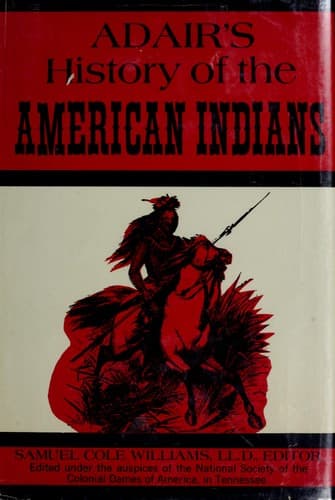
Adair's History of the American IndiansAdair, James
History
Adair's History of the American Indians
Adair, James
Indians -- Origin; Indians of North America -- Southern States
In Tymáhse, a lower Cheerake town, lived one of their reputed great
divine men, who never informed the people of his seeking for rain, but
at the change, or full of the moon, unless there was some promising sign
of the change of the weather, either in the upper regions, or from the
feathered kalender; such as the quacking of ducks, the croaking of
ravens, and from the moistness of the air felt in their quills;
consequently, he seldom failed of success, which highly increased his
name, and profits; for even when it rained at other times, they ascribed
it to the intercession of their great beloved man. Rain-making, in the
Cheerake mountains, is not so dangerous an office, as in the rich level
lands of the Chikkasah country, near the Missisippi. The above Cheerake
prophet had a carbuncle, near as big as an egg, which they said he found
where a great rattlesnake lay dead,[36] and that it sparkled with such
surprizing lustre, as to illuminate his dark winter-house, like strong
flashes of continued lightning, to the great terror of the weak, who
durst not upon any account, approach the dreadful fire-darting place,
for fear of sudden death. When he died, it was buried along with him
according to custom, in the town-house of Tymáhse, under the great
beloved cabbin, which stood in the westernmost part of that old fabric,
where they who will run the risk of searching, may luckily find it; but,
if any of that family detected them in disturbing the bones of their
deceased relation, they would resent it as the basest act of hostility.
The inhuman conduct of the avaricious Spaniards toward the dead
Peruvians and Mexicans, irritated the natives, to the highest pitch of
distraction, against those ravaging enemies of humanity. The intense
love the Indians bear to their dead, is the reason that so few have
fallen into the hands of our physicians to dissect, or anatomise. We
will hope also, that from a principle of humanity, our ague-charmers,
and water-casters, who like birds of night keep where the Indians
frequently haunt, would not cut up their fellow-creatures, as was done
by the Spanish butchers in Peru and Mexico.
Public-domain text, read in full here on John Shaqi.
Reviews
Reviews
No reviews yet
Be the first to share your thoughts on this work.
Elsewhere in the archive
Join the Discussion
Join the discussion
Sign in to leave a comment or review.
Sign InorCreate an account