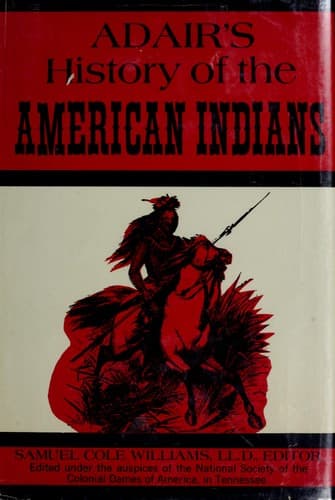
Adair's History of the American IndiansAdair, James
History
Adair's History of the American Indians
Adair, James
Indians -- Origin; Indians of North America -- Southern States
The white people, (I had almost said christians) who have become Indian
proselytes of justice, by living according to the Indian religious
system, assure us, that the Indian men observe the daily sacrifice both
at home, and in the woods, with new-killed venison; but that otherwise
they decline it. The difficulty of getting salt for religious uses from
the sea-shore, and likewise its irritating quality when eaten by those
who have green wounds, might in time occasion them to discontinue that
part of the sacrifice. {115} They make salt for domestic use, out of a
saltish kind of grass, which grows on rocks, by burning it to ashes,
making strong lye of it, and boiling it in earthen pots to a proper
consistence. They do not offer any fruits of the field, except at the
first-fruit-offering: so that their neglect of sacrifice, at certain
times, seems not to be the effect of an ignorant or vicious, but of
their intelligent and virtuous disposition, and to be a strong
circumstantial evidence of their Israelitish extraction.
Though they believe the upper heavens to be inhabited by _Ishtohoollo
Aba_, and a great multitude of inferior good spirits; yet they are
firmly persuaded that the divine omnipresent Spirit of fire and light
resides on earth, in their annual sacred fire while it is unpolluted;
and that he kindly accepts their lawful offerings, if their own conduct
is agreeable to the old divine law, which was delivered to their
forefathers. The former notion of the Deity, is agreeable to those
natural images, with which the divine penmen, through all the prophetic
writings, have drawn YOHEWAH ELOHIM. When God was pleased with Aaron’s
priesthood and offerings, the holy fire descended and consumed the
burnt-offering on the altar, &c.
By the divine records of the Hebrews, this was the emblematical token of
the divine presence; and the smoke of the victim ascending toward
heaven, is represented as a sweet savour to God. The people who have
lived so long apart from the rest of mankind, are not to be wondered at,
if they have forgotten the end and meaning of the sacrifice; and are
rather to be pitied for seeming to believe, like the ignorant part of
the Israelites, that the virtue is either in the form of offering the
sacrifice, or in the divinity they imagine to reside on earth in the
sacred annual fire; likewise, for seeming to have forgotten that the
virtue was in the thing typified.
Public-domain text, read in full here on John Shaqi.
Reviews
Reviews
No reviews yet
Be the first to share your thoughts on this work.
Elsewhere in the archive
Join the Discussion
Join the discussion
Sign in to leave a comment or review.
Sign InorCreate an account