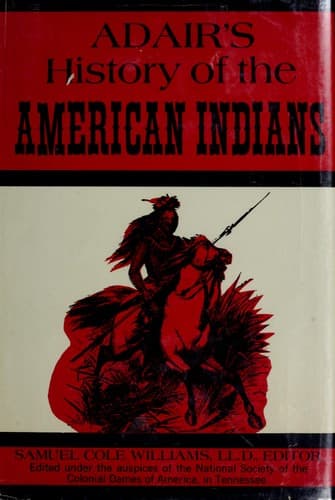
Adair's History of the American IndiansAdair, James
History
Adair's History of the American Indians
Adair, James
Indians -- Origin; Indians of North America -- Southern States
Should any of the Indian women violate this law of purity, they would be
censured, and suffer for any sudden sickness, or death that might happen
among the people, as the necessary effect of the divine anger for their
polluting sin, contrary to their old traditional law of female purity.
Like the greater part of the Israelites, it is the fear of temporal
evils, and the prospect of temporal good, that makes them so tenacious
and observant of their laws. At the stated period, the Indian women’s
impurity is finished by ablution, and they are again admitted to social
and holy privileges.
By the Levitical law, the people who had _running issues_, or _sores_,
were deemed unclean, and strictly ordered apart from the rest, for fear
of polluting them; for every thing they touched became unclean. The
Indians, in as strict a manner, observe the very same law; they follow
the ancient {124} Israelitish copy so close, as to build a small hut at
a considerable distance from the houses of the village, for every one of
their warriors wounded in war, and confine them there, (as the Jewish
lepers formerly were, without the walls of the city) for the space of
four moons, including that moon in which they were wounded, as in the
case of their women after travel: and they keep them strictly separate,
lest the impurity of the one should prevent the cure of the other. The
reputed prophet, or divine physician, daily pays them a due attendance,
always invoking YO HE WAH to bless the means they apply on the sad
occasion; which is chiefly mountain allum, and medicinal herbs, always
injoyning a very abstemious life, prohibiting them women and salt in
particular, during the time of the cure, or sanctifying the reputed
sinners. Like the Israelites, they firmly believe that safety, or
wounds, &c. immediately proceed from the pleased, or angry deity, for
their virtuous, or vicious conduct, in observing, or violating the
divine law.
Public-domain text, read in full here on John Shaqi.
Reviews
Reviews
No reviews yet
Be the first to share your thoughts on this work.
Elsewhere in the archive
Join the Discussion
Join the discussion
Sign in to leave a comment or review.
Sign InorCreate an account