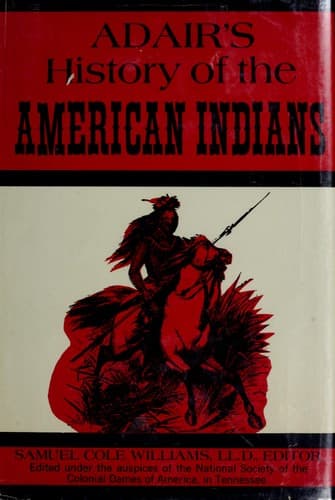
Adair's History of the American IndiansAdair, James
History
Adair's History of the American Indians
Adair, James
Indians -- Origin; Indians of North America -- Southern States
Like the Jews, the greatest part of the southern Indians _abstain_ from
most things that are either in themselves, or in the general
apprehension of mankind, loathsome, or _unclean_: where we find a
deviation from that general rule among any of them, it is a
corruption—either owing to their intercourse with Europeans, or having
contracted an ill habit from necessity. They generally affix very
vicious ideas to the eating of impure things; and all their prophets,
priests, old warriors and war-chieftains, before they enter on their
religious duties, and while they are engaged in them, observe the
strictest abstinence in this point. Formerly, if any of them did eat in
white people’s houses, or even of what had been dressed there, while
they were sanctifying themselves, it was deemed a dangerous sin of
pollution. When some of them first corrupted their primitive virtue, by
drinking of our spirituous liquors, the religious spectators called it
_ooka hoome_, “bitter waters;” alluding, I conjecture, to the bitter
waters of jealousy, that produced swelling and death to those who
committed adultery, but had no power over the innocent. That this name
is not accidental, but designedly pointed, and expressive of the bitter
waters of God, seems obvious, not only from the image they still retain
of them, but likewise when any of them refuse our invitation of drinking
spirituous liquors in company with us, they say _Ahiskola Awa, Ooka
Hoomeh Ishto_, “I will not drink, they are the bitter waters of the
great One.” Though _Ishto_, one of the names of God, subjoined to nouns,
denotes a superlative degree, in this case they deviate from that
general rule—and for this reason they never affix the idea of bitter to
the spirituous liquors we drink among them. _Hoomeh_ is the only word
they have to convey the meaning of bitter; as _Aneh Hoomeh_, “bitter
ears,” or pepper.
Public-domain text, read in full here on John Shaqi.
Reviews
Reviews
No reviews yet
Be the first to share your thoughts on this work.
Elsewhere in the archive
Join the Discussion
Join the discussion
Sign in to leave a comment or review.
Sign InorCreate an account