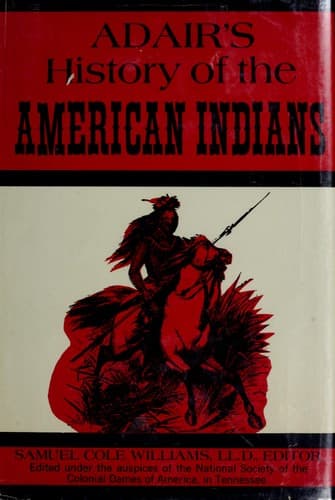
Adair's History of the American IndiansAdair, James
History
Adair's History of the American Indians
Adair, James
Indians -- Origin; Indians of North America -- Southern States
Formerly, this was an universal custom among the native Americans; but
this, like every other usage of theirs, is wearing out apace. The
West-Floridans, in order to keep their women subject to the law of
adultery, bring some venison or buffalo’s flesh to the house of their
normal wives, at the end of every winter’s hunt: that is reckoned a
sufficient annual tye of their former marriages, although the husbands
do not cohabit with them. The Muskóhge men, if newly married, are
obliged by ancient custom, to get their own relations to hoe out the
corn-fields of each of their wives, that their marriages may be
confirmed: and the more jealous, repeat the custom every year, to make
their wives subject to the laws against adultery. But the Indians in
general, reckon that before the bridegroom can presume to any legal
power over the bride, he is after the former ceremonies, or others
something similar, obliged to go into the woods to kill a deer, bring
home the carcass of venison, and lay it down at her house wrapt up in
its skin; and if she opens the pack, carries it into the house, and then
dresses and gives him some of it to eat with cakes before witnesses, she
becomes his lawful wife, and obnoxious to all the penalties of an
adultress.
The Hebrews had another sort of marriage—by purchase: the bridegroom
gave the father of the bride as much as he thought she was worth: and
according to the different valuation, so sooner or later she went off at
market. The only way to know the merit of a Hebrew lady, was to enquire
the value for which her father would sell her, and the less rapacious he
was, the sooner she might get an husband. Divine writ abounds with
instances of the like kind; as Gen. xxxiv. 12. “Ask me never so much
dowry and I will give it.” David bought Michal, and Jacob dearly
purchased Rachel, &c. The women brought nothing with them, except their
clothes, rings and bracelets, and a few trinkets. When the Indians would
express a proper marriage, they have a word adapted according to their
various dialects, to give them a suitable idea of it; but when they are
{140} speaking of their sensual marriage bargains, they always term it,
“buying a woman;” for example—they say with regard to the former,
_Che-Awalas_, “I shall marry you,” the last syllable denotes the first
person of the future tense, the former, “I shall make you, as _Awa_, or
_Hewa_ was to _Ish_,” which is confirmed by a strong negative similar
expression, _Che-Awala Awa_, “I shall not marry you.” But the name of
their market marriages, is _Otoopha, Eho Achumbàras, Saookcháa_, “In the
spring, I shall buy a woman, if I am alive.” Or _Eho Achumbàra Awa_, “I
shall not buy a woman,” _Sàlbasa toogat_, “for indeed I am poor:” the
former usage, and method of language is exactly calculated to express
that singular custom of the Hebrews, per coemptionem.
Public-domain text, read in full here on John Shaqi.
Reviews
Reviews
No reviews yet
Be the first to share your thoughts on this work.
Elsewhere in the archive
Join the Discussion
Join the discussion
Sign in to leave a comment or review.
Sign InorCreate an account