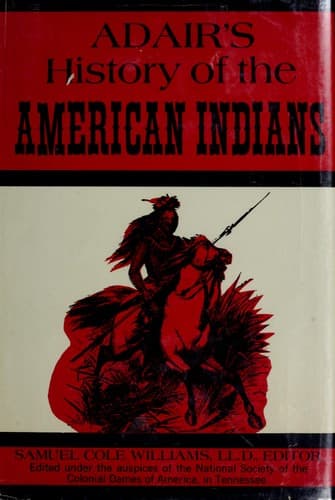
Adair's History of the American IndiansAdair, James
History
Adair's History of the American Indians
Adair, James
Indians -- Origin; Indians of North America -- Southern States
When they have had success in killing the enemy, they tie fire-brands in
the most-frequented places, with grape vines which hang pretty low, in
order that they may be readily seen by the enemy. As they reckon the
aggressors have loudly declared war, it would be madness or treachery in
their opinion to use such public formalities before they have revenged
crying blood; it would inform the enemy of their design of retaliating,
and destroy the honest intention of war. They likewise strip the bark
off several large trees in conspicuous places, and paint them with red
and black hieroglyphics, thereby threatening the enemy with more blood
and death. The last were strong and similar emblems with the Hebrews,
and the first is analogous to one of their martial customs; for when
they arrived at the enemies territories, they threw a fire-brand within
their land, as an emblem of the anger of _Ash_, “the holy fire” for
their ill deeds to his peculiarly beloved people. To which custom
Obadiah alludes, when he says (ver. 18.) “they shall kindle in them and
devour them, there shall not be any remaining of the house of Esau, &c.”
which the Septuagint translates, “one who carries a fire-brand.” The
conduct of the Israelitish champion, Sampson, against the Philistines,
proceeded from the same war custom, when he took three-hundred
_Shugnalim_, (which is a bold strong metaphor) signifying _Vulpes_,
foxes or sheaves of corn; and tying them tail to tail, or one end to the
other in a continued train, he set fire to them, and by that means,
burned down their standing corn.
In the late Cheerake war, at the earnest persuasions of the trading
people, several of the Muskohge warriors came down to the
barrier-settlements of Georgia, {148} to go against the Cheerake, and
revenge English crying blood: but the main body of the nation sent a
running embassy to the merchants there, requesting them immediately to
forbear their unfriendly proceedings, otherwise, they should be forced
by disagreeable necessity to revenge their relations blood if it should
chance to be spilt contrary to their ancient laws: this alludes to the
levitical law, by which he who decoyed another to his end, was deemed
the occasion of his death, and consequently answerable for it. If an
unruly horse belonging to a white man, should chance to be tied at a
trading house and kill one of the Indians, either the owner of the
house, or the person who tied the beast there, is responsible for it, by
their lex talionis; which seems to be derived also from the Mosaic
precept,—if an ox known by its owner to push with its horn, should kill
a person, they were both to die the death. If the Indians have a dislike
to a person, who by any casualty was the death of one of their people,
he stands accountable, and will certainly suffer for it, unless he takes
sanctuary.
Public-domain text, read in full here on John Shaqi.
Reviews
Reviews
No reviews yet
Be the first to share your thoughts on this work.
Elsewhere in the archive
Join the Discussion
Join the discussion
Sign in to leave a comment or review.
Sign InorCreate an account