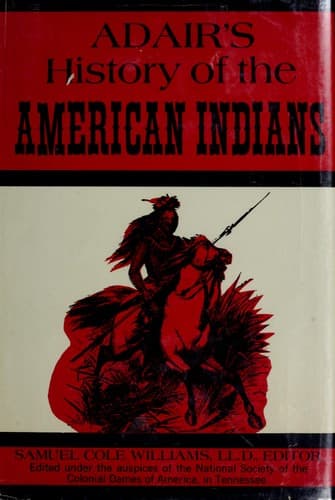
Adair's History of the American IndiansAdair, James
History
Adair's History of the American Indians
Adair, James
Indians -- Origin; Indians of North America -- Southern States
When they are disaffected, or intend to declare war, they will not
allow any of the party against whom they have hostile views, to
approach the white seat; as their holy men, and holy places, are
considered firmly bound to keep good faith, and give sure refuge.
Indeed in the year 1750, after having narrowly escaped with my life
from the Cheerake lower towns, I met two worthy gentlemen at the
settlement of Ninety-six, who were going to them. I earnestly
dissuaded them against pursuing their journey, but without effect:
when they arrived at the middle Cheerake towns, the old beloved men
and war chieftains invited them and twenty of the traders to go in the
evening to their town-house, to sit on their white beloved seat,
partake of their feast, and smoke together with kindly hearts,
according to their old friendly custom. The gentlemen happily rejected
the invitation, and boldly told them they were apprised of their
treacherous intentions: they braved a little, to surprise and
intimidate the Indians, and then mounted, directed their course toward
the place where a treacherous ambuscade had been laid for them—but
they soon silently took another course, and passing through an
unsuspected difficult marsh, and almost pathless woods, by the dawn of
the morning they reached the Georgia side of Savannah river, which was
about 80 miles, where a body of the Muskohge chanced to be preparing
for war against the treacherous Cheerake. These protected them from
their pursuers, and the gentlemen arrived safe at Augusta, the upper
barrier and Indian mart of Georgia.
The Indians cannot shew greater honour to the greatest potentate on
earth, than to place him in the white seat—invoke YO HE WAH, while {168}
he is drinking the Cusseena, and dance before him with the eagles
tails.[71] When two chieftains are renewing, or perpetuating friendship
with each other, they are treated with the same ceremonies. And in their
circular friendly dances, when they honour their guests, and pledge
themselves to keep good faith with them, they sometimes sing their
divine notes with a very awful air, pointing their right hand towards
the sky. Some years ago, I saw the Kooasahte Indians (two hundred miles
up Mobile river) perform this rite with much solemnity; as if invoking
the deity by their notes and gestures, to enable them to shew good-will
to their fellow-creatures, and to bear witness of their faithful vows
and conduct. This custom is plainly not derived from the old Scythians,
or any other part of the heathen world. Their forms and usages when they
made peace, or pledged faith, and contracted friendship with each other,
were widely different: but to those of the Jews it hath the nearest
resemblance.
ARGUMENT XVII.
The Indian origin and descent may also be in some measure discerned by
their taste for, and kind of ORNAMENTS.[72]
Public-domain text, read in full here on John Shaqi.
Reviews
Reviews
No reviews yet
Be the first to share your thoughts on this work.
Elsewhere in the archive
Join the Discussion
Join the discussion
Sign in to leave a comment or review.
Sign InorCreate an account