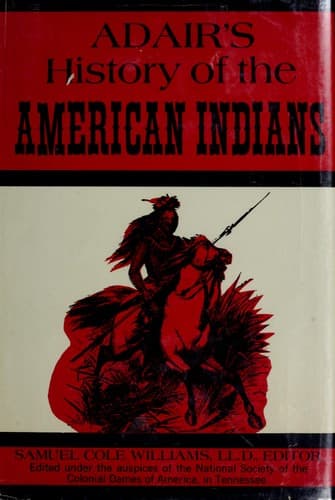
Adair's History of the American IndiansAdair, James
History
Adair's History of the American Indians
Adair, James
Indians -- Origin; Indians of North America -- Southern States
The Hebrews have at all times been very careful in the BURIAL of their
dead—to be deprived of it was considered as one of the greatest of
evils. They made it a point of duty to perform the funeral obsequies of
their friends—often embalmed the dead bodies of those who were rich, and
even buried treasure in the tombs with their dead. Josephus tells us,
that in king David’s sepulchre, was buried such a prodigious quantity of
treasures, that Hyrcanus the Maccabean, took three thousand talents out
of it, about thirteen hundred years after, to get rid of Antiochus then
besieging Jerusalem. And their people of distinction, we are told,
followed the like custom of burying gold and silver with the dead. Thus
it was an universal custom with the ancient Peruvians, when the owner
died to bury his {177} effects with him, which the avaricious Spaniards
perceiving, they robbed these store-houses of the dead of an immense
quantity of treasures. The modern Indians bury all their moveable
riches, according to the custom of the ancient Peruvians and Mexicans,
insomuch, that the grave is heir of all.
Except the Cheerake, only one instance of deviation, from this ancient
and general Indian custom occurs to me: which was that of _Malahche_,
the late famous chieftain of the _Kowwetah_ head war-town of the lower
part of the Muskohge country, who bequeathed all he possessed to his
real, and adopted relations,—being sensible they would be much more
useful to his living friends, than to himself during his long sleep: he
displayed a genius far superior to the crowd.
The Cheerake of late years, by the reiterated persuasion of the traders,
have entirely left off the custom of burying effects with the dead body;
the nearest of blood inherits them. They, and several other of our
Indian nations, used formerly to shoot all the live stock that belonged
to the deceased, soon after the interment of the corpse; not according
to the Pagan custom of the funeral piles, on which they burned several
of the living, that they might accompany and wait on the dead, but from
a narrow-hearted avaricious principle, derived from their Hebrew
progenitors.
Notwithstanding the North-American Indians, like the South-Americans,
inter the whole riches of the deceased with him, and so make his corpse
and the grave heirs of all, they never give them the least disturbance;
even a blood-thirsty enemy will not despoil nor disturb the dead. The
grave proves an asylum, and a sure place of rest to the sleeping person,
till at some certain time, according to their opinion, he rises again to
inherit his favourite place,—unless the covetous, or curious hand of
some foreigner, should break through his sacred bounds. This custom of
burying the dead person’s treasures with him, has entirely swallowed up
their medals, and other monuments of antiquity, without any probability
of recovering them[XLV]. {178}
Footnote XLV:
Public-domain text, read in full here on John Shaqi.
Reviews
Reviews
No reviews yet
Be the first to share your thoughts on this work.
Elsewhere in the archive
Join the Discussion
Join the discussion
Sign in to leave a comment or review.
Sign InorCreate an account