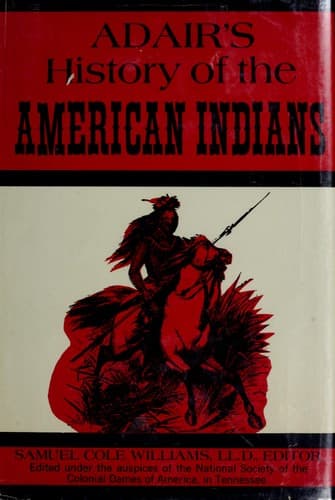
Adair's History of the American IndiansAdair, James
History
Adair's History of the American Indians
Adair, James
Indians -- Origin; Indians of North America -- Southern States
The Katahba Indians call their chief old interpreter, on account of his
obscene language, _Emate-Atikke_, “the smock-interpreter.” The
“_raven_,” is one of the Cheerake favourite war-names. Carolina and
Georgia remember _Quorinnah_, “the raven,” of _Huwhase-town_; he was one
of the most daring warriors of the whole nation, and by far the most
intelligent, and this name, or war-appellative, admirably suited his
well-known character. Though with all the Indian nations, the raven is
deemed an impure bird, yet they have a kind of sacred regard to it,
whether from the traditional knowledge of Noah’s employing it while he
was in the ark, or from that bird having fed Elijah in the wilderness
(as some suppose) cannot be determined; however with our supposed red
Hebrews the name points out an indefatigable, keen, successful warrior.
ARGUMENT XXIII.
Although other resemblances of the Indian rites and customs to those of
the Hebrews, might be pointed out; not to seem tedious, I proceed to the
last argument of the origin of the Indian Americans, which shall be from
their own traditions,—from the accounts of our English writers—and from
the testimonies which the Spanish writers have given, concerning the
primitive inhabitants of Peru and Mexico.
The Indian tradition says, that their forefathers in very remote ages
came from a far distant country, where all the people were of one
colour; and that in process of time they moved eastward, to their
present settlements. So that, what some of our writers have asserted is
not just, who say the Indians affirm, that there were originally three
different tribes in those countries, when the supreme chieftain to
encourage swift running, proposed a proportionable reward of distinction
to each, as they excelled in speed in passing a certain distant river;
as, that the first should be polished white—the second red—and the third
black; which took place accordingly after the race was over. This story
sprung from the innovating superstitious {194} ignorance of the popish
priests, to the south-west of us. Our own Indian tradition is literal,
and not allegorical, and ought to be received; because people who have
been long separated from the rest of mankind, must know their own
traditions the best, and could not be deceived in so material, and
frequently repeated an event.[87] Though they have been disjoined
through different interests, time immemorial; yet, (the rambling tribes
of northern Indians excepted) they aver that they came over the
Missisippi from the westward, before they arrived at their present
settlements. This we see verified by the western old towns they have
left behind them; and by the situation of their old beloved towns, or
places of refuge, lying about a west course from each different nation.
Such places in Judea were chiefly built in the most remote parts of the
country; and the Indians deem those only as beloved towns, where they
first settled.
Public-domain text, read in full here on John Shaqi.
Reviews
Reviews
No reviews yet
Be the first to share your thoughts on this work.
Elsewhere in the archive
Join the Discussion
Join the discussion
Sign in to leave a comment or review.
Sign InorCreate an account