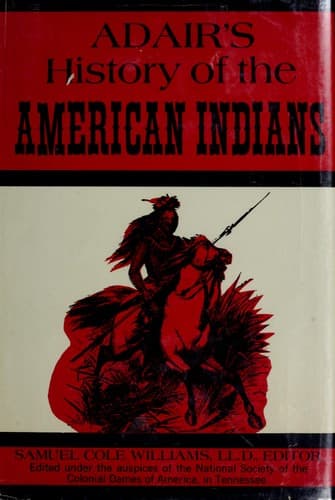
Adair's History of the American IndiansAdair, James
History
Adair's History of the American Indians
Adair, James
Indians -- Origin; Indians of North America -- Southern States
The accounts the Spaniards formerly gave us of Florida and its
inhabitants, are written in the same romantic strain with those of
Mexico. Ramusius tells us, that Alvaro Nunes and his company reported
the Apalahchee Indians to be such a gigantic people, as to carry bows,
thick as a man’s arm, and of eleven or twelve spans long, shooting with
proportional force and direction. It seems they lived then a sober and
temperate life, for Morgues says, one of their kings was three hundred
years old; though Laudon reckons him only two hundred and fifty: and
Morgues assures us, he saw this young Indian Methusalah’s father, who
was fifty years older than his son, and that each of them was likely by
the common course of nature to live thirty or forty years longer,
although they had seen their fifth generation. Since that time they have
so exceedingly degenerated, in height of body, largeness of {200}
defensive arms, and ante-deluvian longevity, that I am afraid, these
early and extraordinary writers would scarcely know the descendants of
those Apalahche Anakim, if they now saw them. They are at present the
same as their dwarfish red neighbours; sic transit gloria mundi.
Nicholaus Challusius paints Florida full of winged serpents; he affirms
he saw one there, and that the old natives were very careful to get its
head, on account of some supposed superstition. Ferdinando Soto tells
us, that when he entered Florida, he found a Spaniard, (J. Ortez) whom
the natives had captivated during the space of twelve years,
consequently he must have gained in that time, sufficient skill in their
dialect to give a true interpretation and account—and he assures us,
that Ucita, the Lord of the place, made that fellow, “Temple-keeper,” to
prevent the night-wolves from carrying away the dead corpse; that the
natives worshipped the devil, and sacrificed to him the life and blood
of most of their captives;—who spoke with them face to face, and ordered
them to bring those offerings to quench his burning thirst. And we are
told by Benzo,[91] that when Soto died, the good-natured Cacique ordered
two likely young Indians to be killed according to custom, to wait on
him where he was gone.—But the Christian Spaniards denied his death, and
assured them he was the son of God, and therefore could not die. If we
except the last sentence, which bears a just analogy to the presumption
and arrogance of the popish priests and historians, time and opportunity
have fully convinced us, that all the rest is calumny and falshood. It
must be confessed however, that none, even of the Spanish monks and
friars, have gone so deep in the marvellous, as our own sagacious David
Ingram—he assures us, “that he not only heard of very surprising animals
in these parts of the world, but saw elephants, horses, and strange wild
animals twice as big as our species of horses, formed like a grey-hound
in their hinder parts; he saw likewise bulls with ears like hounds; and
Public-domain text, read in full here on John Shaqi.
Reviews
Reviews
No reviews yet
Be the first to share your thoughts on this work.
Elsewhere in the archive