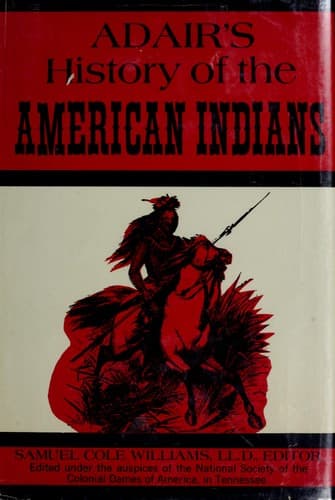
Adair's History of the American IndiansAdair, James
History
Adair's History of the American Indians
Adair, James
Indians -- Origin; Indians of North America -- Southern States
The ornaments of the Indians of South and North America, were formerly,
and still are alike, without the least difference, except in value.
Those superficial writers agree, that the men and women of Peru and
Mexico wore golden ear-rings, and bracelets around their necks and
wrists; that the men wore rings of the same metal in their nose, marked
their bodies with various figures, painted their faces red, and the
women their cheeks, which seems to have been a very early and general
custom. They tell us, that the coronation of the Indian kings, and
installment of their nobles, was solemnized with comedies, banquets,
lights, &c. and that no plebeians were allowed to serve before their
kings; they must be knights, or noblemen. All those sounding high titles
are only a confused picture of the general method of the Indians in
crowning their warriors, performing their war-dances, and esteeming
those fellows as old women, who never attended the reputed holy ark with
success for the beloved brethren.
Don Antonio de Ulloa[96] informs us, that some of the South-American
natives cut the lobes of their ears, and for a considerable time,
fastened small weights to them, in order to lengthen them; that others
cut holes in their upper and under lips; through the cartilege of the
nose, their chins, and jaws, and either hung or thrust through them,
such things as they most fancied, which also agrees with the ancient
customs of our Northern Indians.
Emanuel de Moraes and Acosta affirm, that the Brasilians marry in their
own family, or tribe. And Jo. de Laet. says, they call their uncles and
aunts, “fathers and mothers,” which is a custom of the Hebrews, and of
all our North-American Indians: and he assures us they mourn very much
for their dead; and that their clothes are like those of the early Jews.
{213}
Ulloa assures us, that the South American Indians have no other method
of weaving carpets, quilts, and other stuffs, but to count the threads
one by one, when they are passing the woof;—that they spin cotton and
linnen, as their chief manufacture, and paint their cloth with the
images of men, beasts, birds, fishes, trees, flowers, &c. and that each
of those webs was adapted to one certain use, without being cut, and
that their patience was equal to so arduous a task. According to this
description, there is not the least disparity between the ancient
North-American method of manufacturing, and that of the South Americans.
Acosta writes, that the clothes of the South-American Indians are shaped
like those of the ancient Jews, being a square little cloak, and a
little coat: and the Rev. Mr. Thorowgood,[97] anno 1650, observes, that
this is a proof of some weight in shewing their original descent;
especially to such who pay a deference to Seneca’s parallel arguments of
the Spaniards having settled Italy; for the old mode of dress is
universally alike, among the Indian Americans.
Public-domain text, read in full here on John Shaqi.
Reviews
Reviews
No reviews yet
Be the first to share your thoughts on this work.
Elsewhere in the archive
Join the Discussion
Join the discussion
Sign in to leave a comment or review.
Sign InorCreate an account