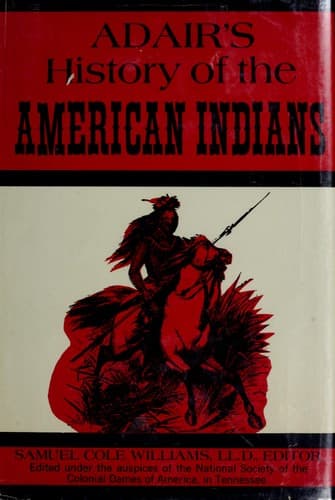
Adair's History of the American IndiansAdair, James
History
Adair's History of the American Indians
Adair, James
Indians -- Origin; Indians of North America -- Southern States
the greatest necessity, he might be confined to the stygian waters.
Those who had their minds more inlarged, diverted themselves much at
their cost, {231} for it was a noted favourite place, on account of the
name it went by; and being a well-situated and good spring, there all
travellers commonly drank a bottle of choice: But now, most of the
packhorse-men, though they be dry, and also matchless sons of Bacchus,
on the most pressing invitations to drink there, would swear to forfeit
sacred liquor the better part of their lives, rather than basely renew,
or confirm the loss of their liberty, which that execrable fountain
occasions.
Footnote LIV:
So named from an early commissioner of Indian affairs. (A). Maj. John
Herbert who made a map of the Cherokee Country in 1715. In January of
that year he accompanied Col. George Chicken on a journey towards the
Tennessee Country, which Chicken journalized. Describing the spot, he
wrote: “We come to ye top of ye mountain and there we see the hade of
a River that Rones in to Chattahoushey River; about a mile on ye other
side of ye mountain ther begon ye hade of another River that Rones
into masashipey (Mississippi). Ouer march this day was 40 miles. Wee
come to Quoneashee ⅐ hower after 5 a clocke where ye River that we see
ye hade of was verry brode.” _Charleston Year Book for 1894_, p. 315.
(W)
About the year 1738, the Cheerake[118] received a most depopulating
shock, by the small pox, which reduced them almost one half, in about a
year’s time: it was conveyed into Charlestown by the Guinea-men,[119]
and soon after among them, by the infected goods. At first it made slow
advances, and as it was a foreign, and to them a strange disease, they
were so deficient in proper skill, that they alternately applied a
regimen of hot and cold things, to those who were infected. The old magi
and religious physicians who were consulted on so alarming a crisis,
reported the sickness had been sent among them, on account of the
adulterous intercourses of their young married people, who the past
year, had in a most notorious manner, violated their ancient laws of
marriage in every thicket, and broke down and polluted many of the
honest neighbours bean-plots, by their heinous crimes, which would cost
a great deal of trouble to purify again. To those flagitious crimes they
ascribed the present disease, as a necessary effect of the divine anger;
and indeed the religious men chanced to suffer the most in their small
fields, as being contiguous to the town-house, where they usually met at
night to dance, when their corn was out of the stalks; upon this pique,
they shewed their priest-craft. However, it was thought needful on this
occasion, to endeavour to put a stop to the progress of such a dangerous
disease: and as it was believed to be brought on them by their unlawful
copulation in the night dews, it was thought most practicable to try to
effect the cure, under the same cool element.
Public-domain text, read in full here on John Shaqi.
Reviews
Reviews
No reviews yet
Be the first to share your thoughts on this work.
Elsewhere in the archive
Join the Discussion
Join the discussion
Sign in to leave a comment or review.
Sign InorCreate an account