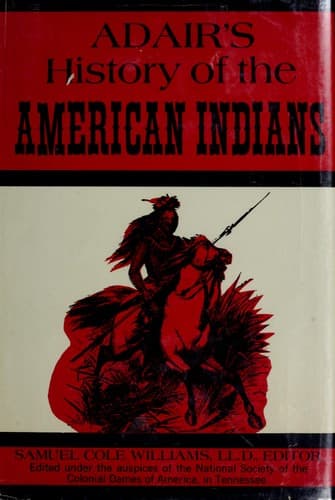
Adair's History of the American IndiansAdair, James
History
Adair's History of the American Indians
Adair, James
Indians -- Origin; Indians of North America -- Southern States
In the year 1749, I came down, by the invitation of the governor of
South-Carolina, to Charles-Town, with a body of our friendly Chikkasah
Indians: one of his majesty’s surgeons, that very day we arrived, cut
off the wounded arm of a poor man. On my relating it to the Indians,
they were shocked at the information, and said, “The man’s poverty
should have induced him to exert the common skill of mankind, in so
trifling an hurt; especially, as such a butchery would not only
disfigure, but disable the poor man the rest of his life; that there
would have been more humanity in cutting off the head, than in such a
barbarous amputation, because it is much better for men to die once,
than to be always dying, for when the hand is lost, how can the poor man
feed himself by his daily labour—By the same rule of physic, had he been
wounded in his head, our surgeons should have cut that off, for being
unfortunate.” I told the benevolent old warriors, that the wisdom of our
laws had exempted the head from such severe treatment, by not settling a
reward for severing it, but only so much for every joint of the branches
of the body, which might be well enough spared, without the life; and
that this medical treatment was a strong certificate to recommend the
poor man to genteel lodgings, where numbers belonging to our great
canoes, were provided for during life.[121] They were of opinion
however, that such brave hardy fellows would rather be deemed men, and
work for their bread, than be laid aside, not only as useless animals,
but as burdens to the rest of society.
I do not remember to have seen or heard of an Indian dying by the bite
of a snake, when out at war, or a hunting; although they are then often
bitten by the most dangerous snakes—every one carries in his shot-pouch,
a piece of the best snake-root, such as the _Seneeka_, or
fern-snake-root,—or the wild hore-hound, wild plantain, St. Andrew’s
cross, and a variety of other herbs and roots, which are plenty, and
well known to those who range the American woods, and are exposed to
such dangers, and will effect a thorough and speedy cure if timely
applied. When an Indian perceives he is struck by a snake, he
immediately chews some of the root, and having swallowed a sufficient
quantity of it, he applies some to the wound; which he repeats as
occasion requires, and in proportion to the poison the snake has infused
into the wound. For a short space of time, there is a terrible conflict
through all the body, by the jarring qualities of {235} the burning
poison, and the strong antidote; but the poison is soon repelled through
the same channels it entered, and the patient is cured.
Public-domain text, read in full here on John Shaqi.
Reviews
Reviews
No reviews yet
Be the first to share your thoughts on this work.
Elsewhere in the archive
Join the Discussion
Join the discussion
Sign in to leave a comment or review.
Sign InorCreate an account