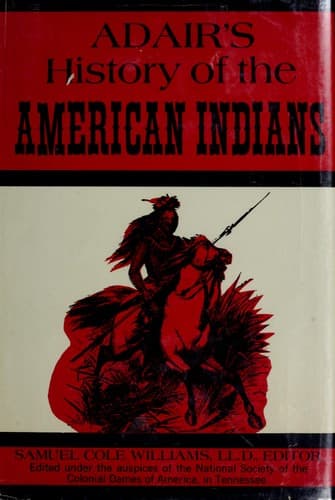
Adair's History of the American IndiansAdair, James
History
Adair's History of the American Indians
Adair, James
Indians -- Origin; Indians of North America -- Southern States
The French, to draw off the western towns, had given them repeated
assurances of settling a strong garrison on the north side of their
river, as high up as their large pettiaugres could be brought with
safety, where there was a large tract of rich lands abounding with game
and fowl, and the river with fish.—They at the same time promised to
procure a firm peace between the Cheerake and all the Indian nations
depending on the French; and to bestow on them powder, bullets, flints,
knives, scissars, combs, shirts, looking glasses, and red paint,—beside
favourite trifles to the fair sex: in the same brotherly manner the
Alebahma French extended their kindly hands to their Muskohge brethren.
By their assiduous endeavours, that artful plan was well supported, and
though the situation of our affairs, in the remote, and leading Cheerake
towns, had been in a ticklish situation, from the time their project of
an empire was formed; and though several other towns became uneasy and
discontented on sundry pretexts, for the space of two years before the
unlucky occasion of the succeeding war happened—yet his excellency our
governor[129] neglected the proper measures to reconcile the wavering
savages, till the gentleman[130] who was appointed to succeed him, had
just reached the American coast: then, indeed, he set off, with a
considerable number of gentlemen, in flourishing parade, and went as far
as Ninety-six[LV] settlement; from whence, as most probably he expected,
he was fortunately recalled, and joyfully superseded. I saw him on his
way up, and plainly observed he was unprovided for the journey; it must
unavoidably have proved abortive {244} before he could have proceeded
through the Cheerake country,—gratifying the inquisitive disposition of
the people, as he went, and quieting the jealous minds of the
inhabitants of those towns, who are settled among the Apalahche
mountains, and those seven towns, in particular, that lie beyond them.
He neither sent before, nor carried with him, any presents wherewith to
soothe the natives; and his kind promises, and smooth speeches, would
have weighed exceedingly light in the Indian scale.
Footnote LV:
So called from its distance of miles from the Cheerake. (A). Adair
makes a slight slip here. Ninety-Six was the name applied as early as
1730 to the point ninety-six miles _from Charles Town_. Salley,
_George Hunter’s Map of 1730_, p. 3. (W)
Public-domain text, read in full here on John Shaqi.
Reviews
Reviews
No reviews yet
Be the first to share your thoughts on this work.
Elsewhere in the archive
Join the Discussion
Join the discussion
Sign in to leave a comment or review.
Sign InorCreate an account