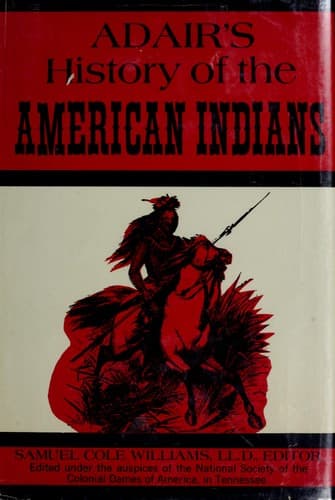
Adair's History of the American IndiansAdair, James
History
Adair's History of the American Indians
Adair, James
Indians -- Origin; Indians of North America -- Southern States
themselves in the Cheerake country, where the late Fort-Loudon stood,
near the conflux of Great Telliko and Tennase-rivers, and so distress
our southern colonies, as the body of the Cheerake, Muskohge, Choktah,
Aquahpa, and the upper Missisippi-Indians headed by the French, would be
able to maintain a certain successful war against us, if well supplied
with ammunition. Their deliberations were short—they soon sent off a
large pettiaugre, sufficiently laden with warlike stores, and decoying
presents; and in obedience to the orders the crew had received of making
all the dispatch they possibly could, in the third moon of their
departure from New Orleans, they arrived within a hundred and twenty
computed miles of those towns that are a little above the unhappy
Fort-Loudon: there they were luckily stopped in their mischievous
career, by a deep and dangerous cataract; the waters of which rolled
down with a prodigious rapidity, dashed against the opposite rocks, and
from thence rushed off with impetuous violence, on a quarter-angled
course.[154] It appeared so shocking and unsurmountable to the
monsieurs, that after staying there a considerable time, in the vain
expectation of seeing some of their friends, necessity forced them to
return back to New Orleans, about 2600 computed miles, to their
inconsolable disappointment.
These circumstances are now well known to our colonies: and, if our
state policy had not sufficiently discovered itself of late, it would
appear not a little surprising that the Great Mortar, should have such
influence on the great beloved man, (so the Indians term the
superintendant) as to move him, at a congress in Augusta, to write by
that bitter enemy of the English name, a conciliating letter to the
almost-vanquished and desponding Choktah—for where the conquerors have
not an oblique point in {269} view, the conquered are always the first
who humbly sue for peace. This beloved epistle, that accompanied the
eagles-tails, swans-wings, white beads, white pipes, and tobacco, was
sent by a white interpreter, and _Mesheshecke_, a Muskohge
war-chieftain, to the perfidious Choktah, as a strong confirmation of
peace. Without doubt it was a master stroke of court-policy, to strive
to gain so many expert red auxiliaries; and plainly shews how extremely
well he deserves his profitable place of public trust. I am assured by
two respectable, intelligent, old Indian traders, G. G. and L. M. G.
Esq;[155] that they frequently dissuaded him from ever dabling in such
muddy waters; for the consequence would unavoidably prove fatal to our
contiguous colonies. This was confirmed by a recent instance—the late
Cheerake war, which could not have commenced, if the Muskohge and
Cheerake had not been reconciled, by the assiduous endeavours of an
avaricious, and self-interested governor. If any reader reckons this too
bold, or personal, I request him to peruse a performance, entitled, “A
modest reply to his Excellency J. G.
Public-domain text, read in full here on John Shaqi.
Reviews
Reviews
No reviews yet
Be the first to share your thoughts on this work.
Elsewhere in the archive
Join the Discussion
Join the discussion
Sign in to leave a comment or review.
Sign InorCreate an account