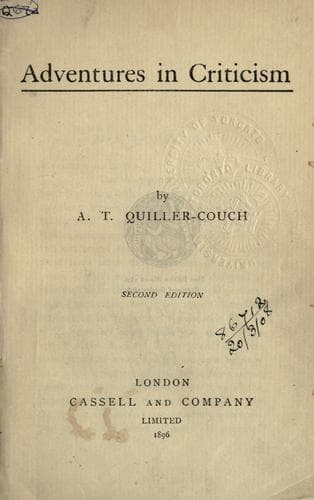
Nov. 18, 1893. Story and Anecdote.
I suppose I am no more favored than most people who write stories in
receiving from unknown correspondents a variety of suggestions,
outlines of plots, sketches of situations, characters, and so forth.
One cannot but feel grateful for all this spontaneous beneficence. The
mischief is that in ninety-nine cases out of a hundred (the fraction
is really much smaller) these suggestions are of no possible use.
Why should this be? Put briefly, the reason is that a story differs
from an anecdote. I take the first two instances that come into my
head: but they happen to be striking ones, and, as they occur in a
book of Mr. Kipling's, are safe to be well known to all my
correspondents. In Mr. Kipling's fascinating book, _Life's Handicap,
On Greenhow Hill_ is a story; _The Lang Men o' Larut_ is an anecdote.
_On Greenhow Hill_ is founded on a study of the human heart, and it is
upon the human heart that the tale constrains one's interest. _The
Lang Men o' Larut_ is just a yarn spun for the yarn's sake: it informs
us of nothing, and is closely related (if I may use some of Mr.
Howells' expressive language for the occasion) to "the lies swapped
between men after the ladies have left the table." And the reason why
the story-teller, when (as will happen at times) his invention runs
dry, can take no comfort in the generous outpourings of his unknown
friends, is just this--that the plots are merely plots, and the
anecdotes merely anecdotes, and the difference between these and a
story that shall reveal something concerning men and women is just the
difference between bad and good art.
Let us go a step further. At first sight it seems a superfluous
contention that a novelist's rank depends upon what he can see and
what he can tell us of the human heart. But, as a matter of fact, you
will find that four-fifths at least of contemporary criticism is
devoted to matters quite different--to what I will call Externals, or
the Accidents of Story-telling: and that, as a consequence, our
novelists are spending a quite unreasonable proportion of their labor
upon Externals. I wrote "as a consequence" hastily, because it is
always easier to blame the critics. If the truth were known, I dare
say the novelists began it with their talk about "documents," "the
scientific method," "observation and experiment," and the like.
The Fallacy of "Documents."
Public-domain text, read in full here on John Shaqi.
Reviews
Reviews
No reviews yet
Be the first to share your thoughts on this work.
Elsewhere in the archive
Join the Discussion
Join the discussion
Sign in to leave a comment or review.
Sign InorCreate an account