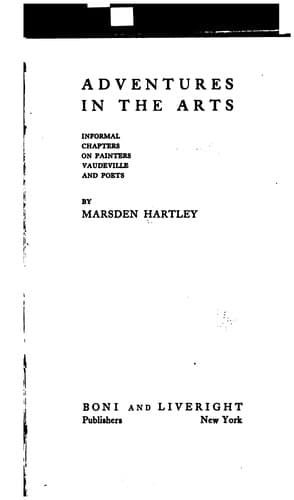
Adventures in the Arts: Informal Chapters on Painters, Vaudeville, and PoetsHartley, Marsden
History
Adventures in the Arts: Informal Chapters on Painters, Vaudeville, and Poets
Hartley, Marsden
Art; Literature, Modern -- History and criticism; Vaudeville
He was the poet of the lost treasure. "Studies in Sentiment" is, I
think, the title of a small book of prose of his. He might have called
his poems "Studies in sentimentality". And yet, for his time, how
virile and vigorous he sounds beside "Posies out of Rings", of his
friend Theodore Peters, of the renaissance cloak, the cherry coloured
velvet cloak embroidered in green leaves and silver veinings, so full
of the sky radiance of Dowson himself, this cloak. Cherry sounds red
and passionate. But it was a cherry of olden time, with the bloom
quite gone, the dust of the years permeating its silken warp. It
reposes here in America, the property of an artist of that period.
One likes Dowson because of his sincerity, and a clear beauty which,
if not exactly startling, was in its way truly genuine. It was merely
too late for Dowson, and it was probably too soon. Swinburne had
strummed the skies with every kind of song, and Verlaine had whispered
every secret of the senses there was, in the land of illusion and
vaguery. Dowson was worshipper of them both, for it was sound first
and last that he cared most for, the musical mastery of the one and
the sentimentality of the other. He was far nearer Verlaine in type.
He had but the one thing to tell of, and that was lost love, and he
told it over and over in his book of verse. His Pierrot of the Minute
was himself, and his Cynara was the ever vanishing vision of his own
insecurity and incapability. He perished for the love of hands. He is
so like someone one knows, whom one wants to talk to tenderly, touch
in a friendly way, and say as little as possible. He comes to one
humanly first, and asks you for your eye to his verse afterward,
something of the "Little boy Lost", in his so ineffectual face, weak
with sweetness and hidden in shyness, covered with irresponsibility,
or lack of power to be responsible.
He was a helpless one, that is certain. He resorted to the
old-fashioned methods of the decadents for maintaining the certain
requisite melancholy apparently necessary to sing a certain way. In
the struggle of that period, he must have seemed like a very clear,
though a very sad singer. There were no lilies or orchids in his
buttonhole, and no strange jewels on his fingers, for you remember, it
was the time of "Monsieur Phocas", and the art of Gustave Moreau. He
was plain and sincere, and pathetic, old-fashioned too in that he was
bohemian, or at least had acquired bohemianism, for I think no
Englishman was ever really bohemian. Dieppe and the docks had gotten
him, and took away the sense of mastery over things that a real poet
of power must somehow have. He was essentially a giver-in. His
neurasthenia was probably the reason for that. It was the age of
absinthe and little taverns, for there was Verlaine and the inimitable
Cafe d'Harcourt, which, as you saw it just before the war, had the
very something that kept the Master at his drinks all day.
Public-domain text, read in full here on John Shaqi.
Reviews
Reviews
No reviews yet
Be the first to share your thoughts on this work.
Elsewhere in the archive
Join the Discussion
Join the discussion
Sign in to leave a comment or review.
Sign InorCreate an account