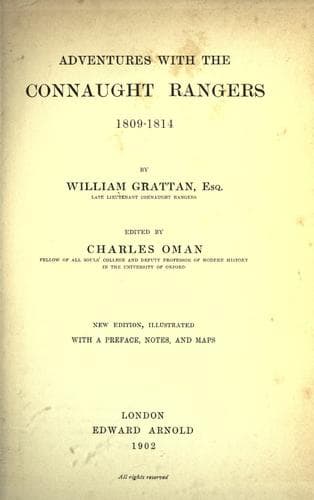
Adventures with the Connaught Rangers, 1809-1814Grattan, William
History
Adventures with the Connaught Rangers, 1809-1814
Grattan, William
Great Britain. Army. Regiment of Foot, 88th (Connaught Rangers); Peninsular War, 1807-1814 -- Personal narratives
Early on the morning of the 19th, the 3rd Division (although not for
duty that day) received orders to march to the Convent of La Caridad;
and as Lord Wellington was not in the habit of giving us unnecessary
marches, we concluded that he intended us the honour of forming one of
the corps destined to carry the place. On our march we perceived our old
friends and companions, the Light Division, debouching from their
cantonments, and the joy expressed by our men when they saw them is not
to be described; we were long acquainted, and like horses accustomed to
the same harness, we pulled well together. At two o’clock in the
afternoon we left La Caridad, and, passing to the rear of the first
parallel, formed in column about two gun-shots distant from the main
breach. The 4th Division still occupied the works, and it was the
general opinion that ours (the 3rd) were to be in reserve. The number of
Spaniards, Portuguese, and soldiers' wives in the character of sutlers,
was immense, and the neighbourhood, which but a few days before was only
an empty plain, now presented the appearance of a vast camp. Wretches of
the poorest description hovered round us, in hopes of getting a morsel
of food, or of plundering some dead or wounded soldier: their cadaverous
countenances expressed a living picture of the greatest want; and it
required all our precaution to prevent these miscreants from robbing us
the instant we turned our backs from our scanty store of baggage or
provisions.
Our bivouac, as may be supposed, presented an animated appearance—groups
of soldiers cooking in one place; in another, some dozens collected
together, listening to accounts brought from the works by some of their
companions whom curiosity had led thither; others relating their past
battles to any of the young soldiers who had not as yet come
hand-to-hand with a Frenchman; others dancing and singing; officers'
servants preparing dinner for their masters; and officers themselves,
dressed in whatever way best suited their taste or convenience, mixed
with the men, without any distinguishing mark of uniform to denote their
rank. The only thing uniform to be discovered amongst a group of between
four and five thousand was good conduct and confidence in themselves and
their general.
Public-domain text, read in full here on John Shaqi.
Reviews
Reviews
No reviews yet
Be the first to share your thoughts on this work.
Elsewhere in the archive
Join the Discussion
Join the discussion
Sign in to leave a comment or review.
Sign InorCreate an account