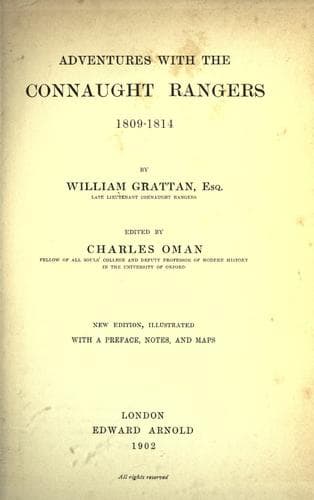
Adventures with the Connaught Rangers, 1809-1814Grattan, William
History
Adventures with the Connaught Rangers, 1809-1814
Grattan, William
Great Britain. Army. Regiment of Foot, 88th (Connaught Rangers); Peninsular War, 1807-1814 -- Personal narratives
I quitted the breach, and took a parting glance at the town; the smell
from the still burning houses, the groups of dead and wounded, and the
broken fragments of different weapons, marked strongly the character of
the preceding night’s dispute; and even at this late hour, there were
many drunken marauders endeavouring to regain, by some fresh act of
atrocity, an equivalent for the plunder their brutal state of
intoxication had caused them to lose by the hands of their own
companions, who robbed indiscriminately man, woman, or child, friend or
foe, the dead or the dying! Then, again, were to be seen groups of
deserters from our army, who, having taken shelter in Rodrigo during the
winter, were now either dragged from their hiding-places by their
merciless comrades, or given up by the Spaniards, in whose houses they
had sought shelter, to the first officer or soldier who would be
troubled, at the moment, with the responsibility of taking charge of
them.
In the midst of a group of a dozen men, deserters from different
regiments, stood two of the Connaught Rangers. No matter what their
other faults might be, desertion was not a species of delinquency they
were addicted to; and as the fate of one of these men—indeed both of
them, for that matter—was a little tragical, I purpose giving it a nook
in my adventures. The two culprits to whom I have made allusion were as
different in their characters as persons; one of them (Mangin) was a
quiet well-disposed man, short in stature, a native of England, and, as
a matter of course, a heavy feeder, one that could but ill put up with
“short allowance,” and in consequence left the army when food became as
scarce as it did in the winter of 1811. The other, a fellow of the name
of Curtis, an Irishman, tall and lank, was, like the rest of the “boys”
from that part of the world, mighty aisy about what he ate, provided he
got a reasonable supply of drink; but as neither the one nor the other
were “convenient” during the period in question, they both left an
advanced post one fine night, and resolved to try the difference between
the French commissariat and ours. This was their justification of
themselves to me, and I believe, for I was not present at it, the
_summum bonum_ upon which the basis of their defence at their trial
rested. There were also six Germans of the 60th Rifles in the group, but
they seemed so unnerved by their unexpected capture that they were
unable to say anything for themselves.
Public-domain text, read in full here on John Shaqi.
Reviews
Reviews
No reviews yet
Be the first to share your thoughts on this work.
Elsewhere in the archive
Join the Discussion
Join the discussion
Sign in to leave a comment or review.
Sign InorCreate an account