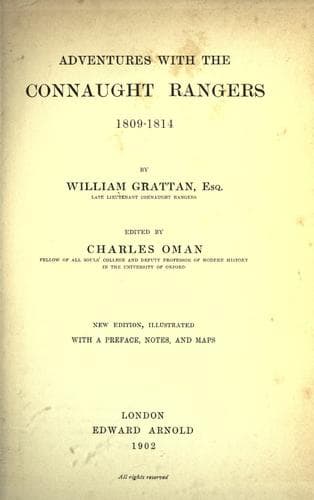
Adventures with the Connaught Rangers, 1809-1814Grattan, William
History
Adventures with the Connaught Rangers, 1809-1814
Grattan, William
Great Britain. Army. Regiment of Foot, 88th (Connaught Rangers); Peninsular War, 1807-1814 -- Personal narratives
The French cannoniers were loud in cheering when they discovered the
effects of their fire upon Cooney’s sconce; our men cheered in turn, and
continued to crown the top of the already half-dismantled magazine, but
as fast as they mounted it, they were swept off its face by the
overwhelming fire from the town; yet notwithstanding the great loss of
lives that had already taken place, and the almost certain death which
awaited all who attempted to remain on the magazine, it was never for
five minutes unoccupied, and by four o’clock in the afternoon it might
be said to be perfectly finished. Baffled in his endeavours to stop our
progress, Phillipon was determined to make it cost us as dear as he
could. Twelve additional guns were brought from the unemployed batteries
and placed along the curtain _en barbette_. These, at half-range
distance, without the means on our side to reply to them, were fired
with a fearful precision; it was next to impossible to stand under it,
but the soldiers, on this day, surpassed all their former efforts. The
fire of threescore pieces of artillery was employed in vain against
them; the works were repaired so soon as injured, and everything
warranted the opinion that, should the night prove fine, our batteries
would open the following day.
Captain Mulcaster, of the Engineers, by his heroic conduct, stimulated
the soldiers wonderfully; no danger could unnerve him, or prevent his
exposing himself to the hottest of the French fire, and for a time he
escaped unhurt, but at length, while standing on a rising ground, in
front of the battery No. 1, a twenty-four pound shot struck him in the
neck, and carried away his head and part of his back and shoulders. The
headless trunk was knocked several yards from the spot, but was speedily
carried to the engineer camp by some of the brave men who, but a few
short moments before, looked upon what was now an inanimate lump of
clay, with that admiration naturally inspired by one of the finest as
well as the most intrepid young men in the army; for he had endeared
himself to the soldiers as much by his kind manner to them as by his
total disregard of danger to himself. It is well known that infantry
soldiers had a great dislike to being placed under the control of the
engineer officers, who exacted, or at least they thought so, too much
from them; but Captain Mulcaster had a manner, peculiar to himself, that
gained him the goodwill of all.
Public-domain text, read in full here on John Shaqi.
Reviews
Reviews
No reviews yet
Be the first to share your thoughts on this work.
Elsewhere in the archive
Join the Discussion
Join the discussion
Sign in to leave a comment or review.
Sign InorCreate an account