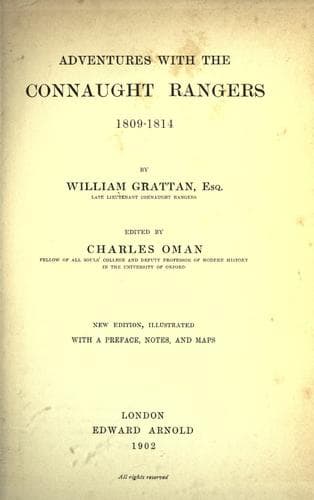
Adventures with the Connaught Rangers, 1809-1814Grattan, William
History
Adventures with the Connaught Rangers, 1809-1814
Grattan, William
Great Britain. Army. Regiment of Foot, 88th (Connaught Rangers); Peninsular War, 1807-1814 -- Personal narratives
My friends, Darcy and Adair, were my companions on my route to the army;
and, punctual at the appointed hour, we left Elvas at six o’clock on the
morning of the 3rd of June, without any encumbrance, such as a
detachment to look after. We had no escort except our three servants,
and Dan’s wife Nelly; and it is needless to say that they were perfectly
competent to take care of themselves, without causing us one moment’s
uneasiness, either on their account or our own; and never did any three
officers in the service of His Britannic Majesty, or in the service of
any other sovereign, set out on a route to join their companions with a
more fervent intention of making the time pass as agreeably as possible.
Our route towards Salamanca, near which city the army was stationed, lay
through the old line of march, and we were obliged, unfortunately, once
more to encounter that place of dirt and wretchedness, Niza. No matter
what change had taken place either amongst ourselves or the different
towns through which we passed, Niza was still the same; positively
dirt—comparatively dirt—superlatively dirt!—dirt! dirt! dirt! The
ditches were filled with reptiles, the houses with bugs and fleas, and
Adair, who was already blind of one eye, had the other nearly darkened
by the bite of a huge centipede. We poulticed his eye with rye bread and
cold water, and in the morning carried him, with a _wry_ face, to his
saddle.
Once clear of Niza, we traversed the country towards the Spanish
frontier; at length we got clear of Portugal, and once more reached the
village of Fuentes d'Oñoro; every house, I might almost say every face,
was familiar to me. The heaps of embanked earth, which denoted the
places where many of our old companions had been interred, were covered
with grass, which grew luxuriantly over the graves of the men who had
once stood there victorious, but who were now lifeless clay. We
traversed the churchyard where so many of the Imperial Guard and our
Highlanders had fallen; and we marked well the street where three
hundred of the former had been put to death by the 88th Regiment. Many
of the doors still retained the marks of the contest; and the chimneys,
up which the Guard had sought shelter, bore the traces of what had taken
place. The torn apertures in the large twigged chimneys, broken down by
the Guard in attempting to get up them, were in the same state we had
left them—untouched, unmended. Even the children could trace with
accuracy the footsteps of those fallen heroes.
Public-domain text, read in full here on John Shaqi.
Reviews
Reviews
No reviews yet
Be the first to share your thoughts on this work.
Elsewhere in the archive
Join the Discussion
Join the discussion
Sign in to leave a comment or review.
Sign InorCreate an account