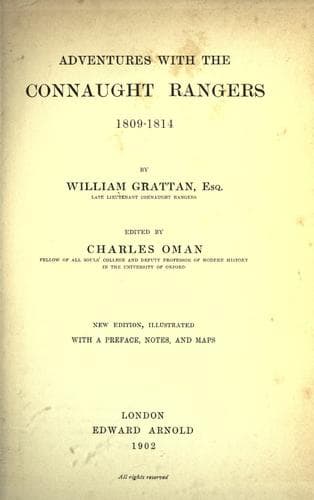
Adventures with the Connaught Rangers, 1809-1814Grattan, William
History
Adventures with the Connaught Rangers, 1809-1814
Grattan, William
Great Britain. Army. Regiment of Foot, 88th (Connaught Rangers); Peninsular War, 1807-1814 -- Personal narratives
On the evening of the 3rd, Picton’s division was abreast of the ford of
Pollos; some cavalry tried the depth of the river, which was deemed
fordable; but the attitude of the enemy on the opposite bank was so
imposing that the idea of forcing the passage was given up. From the 3rd
until the 12th of July the two armies remained in presence of each
other, encamped on each side of a river which at times is a formidable
sheet of water, but which was then little more than an insignificant
stream. Nevertheless, although both armies kept their guards on their
respective sides of the water, and the movements of each were cautiously
watched, not one life was lost, nor one shot fired by either army.
Indeed so different from hostility was the conduct of both nations, that
the French and British lived upon the most amicable terms. If we wanted
wood for the construction of huts, our men were allowed to pass without
molestation to the French side of the river to cut it. Each day the
soldiers of both armies used to bathe together in the same stream, and
an exchange of rations, such as biscuit and rum, between the French and
our men was by no means uncommon. A stop was, however, soon to be put to
this friendly intercourse; and it having been known in both armies that
something was about to be attempted by Marmont, on the evening of the
12th of July, we shook hands with our _vis-à-vis_ neighbours and parted
the best friends.
It is a remarkable fact that the part of the river of which I am
speaking was occupied, on our side, by our 3rd Division, on the French
side by the 7th Division. The French officers said to us on parting, “We
have met, and have been for some time friends. We are about to separate,
and may meet as enemies. As 'friends' we received each other warmly—as
'enemies' we shall do the same.” In ten days afterwards the British 3rd
and the French 7th Divisions were opposed to each other at the battle of
Salamanca—and the 7th French were destroyed by the British 3rd. But I am
now about describing one of the most memorable battles ever fought by
the British army—the battle of Salamanca.
CHAPTER XX
State of the opposing armies previous to the battle of
Salamanca—Preliminary movements—The Duke of Ragusa’s false
movement—Pakenham engaged with the enemy’s left—Defeats the division
under General Thomières—Reinforced, they again advance to the
attack—Their destruction by a brigade of British cavalry—The
Portuguese repulsed—Desperate exertions of the French—Final charge
of Clinton’s division—Complete defeat of the French army.
The situation and position of the hostile armies have been described in
the last chapter; it left them on the banks of the Douro; and the
probability, nay the certainty, that a collision was about to take place
between them was manifest to the lowest soldier of both.
Public-domain text, read in full here on John Shaqi.
Reviews
Reviews
No reviews yet
Be the first to share your thoughts on this work.
Elsewhere in the archive
Join the Discussion
Join the discussion
Sign in to leave a comment or review.
Sign InorCreate an account