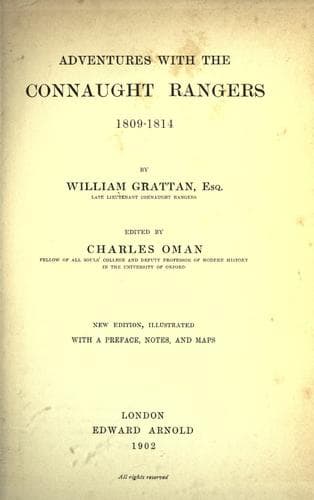
Adventures with the Connaught Rangers, 1809-1814Grattan, William
History
Adventures with the Connaught Rangers, 1809-1814
Grattan, William
Great Britain. Army. Regiment of Foot, 88th (Connaught Rangers); Peninsular War, 1807-1814 -- Personal narratives
The French then advanced in two columns of twenty-five thousand men
each; the intervening space between them might be reckoned at two miles.
The right wing was commanded by Clausel, the left by Marmont in person.
Clausel had scarcely arrived before the point occupied by the 4th
Division, when, seeing the smallness of their force, he conceived the
idea of making a sudden rush, in the hope of cutting them off. His
troops had scarcely formed when he pushed onward at the head of two
divisions of infantry and the brigade of dragoons commanded by General
Carrié; but Cole, placing himself at the head of the 27th and 40th
Regiments, received him with steadiness, and drove the French infantry
back in disorder. Meanwhile Carrié, seeing some open spaces in Cole’s
line, caused by their movement against Clausel’s infantry, thought to
profit by this disorder, and galloping forward at the head of his
troopers, sabred many men; but at this moment the cavalry sent to
sustain Cole met them, and after a severe but short conflict totally
overthrew the brigade of Carrié, who was himself numbered amongst the
prisoners.
The defeat of Clausel and Carrié checked in a great degree the ardour of
the French Marshal. The following day he rested, and on the 19th threw
back his right wing, and moving forward with the left of his army,
menaced the right of the British; but Lord Wellington, anticipating the
movement, was prepared for him, and offered battle on the plain of
Velosa. This was refused on the part of the French General; and from
this until the 20th, the two armies manœuvred within half cannon-shot
of each other, the British retiring as it had advanced—moving, not
directly rearward, but rather in a line parallel with the march of the
French. The columns were in movement in an open country, fairly in the
view of each other, and their respective attitudes were of that novel
sort that it would be difficult to find the like recorded in the history
of any two armies. At times the French and British were within
musket-shot of each other, the soldiers of both in momentary expectation
of being engaged, yet not one shot was fired by either.
Public-domain text, read in full here on John Shaqi.
Reviews
Reviews
No reviews yet
Be the first to share your thoughts on this work.
Elsewhere in the archive
Join the Discussion
Join the discussion
Sign in to leave a comment or review.
Sign InorCreate an account