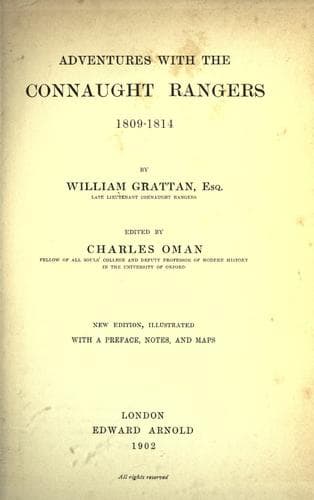
Adventures with the Connaught Rangers, 1809-1814Grattan, William
History
Adventures with the Connaught Rangers, 1809-1814
Grattan, William
Great Britain. Army. Regiment of Foot, 88th (Connaught Rangers); Peninsular War, 1807-1814 -- Personal narratives
The evening of the 21st of July was calm, and appeared settled, but
persons well versed in the symptoms of the horizon, which were
unobserved by those intensely occupied with the anticipations of the
events which the morrow was to produce, pronounced that a hurricane was
not far distant. Pakenham’s division was occupied, as I have before
said, in entrenching itself, when about ten at night a torrent of rain
fell in the trenches, and so completely filled them with water that the
soldiers were obliged to desist from their labour. Later in the night a
storm arose, and the wind howled in long and bitter gusts. This was
succeeded by peals of thunder and flashes of lightning, so loud and
vivid that the horses of the cavalry, which were ready saddled, took
alarm, and forcing the pickets which held them, ran away affrighted in
every direction. The thunder rolled in rattling peals, the lightning
darted through the black and almost suffocating atmosphere, and
presented to the view of the soldiers of the two armies the horses as
they ran about from regiment to regiment, or allowed themselves to be
led back to their bivouac by the troopers to whom they belonged. The
vivid flashes of lightning, which seemed to rest upon the grass, for a
few moments wholly illuminated the plain, and the succeeding flashes
occurred with such rapidity that a constant blaze filled the space
occupied by both armies. It was long before the horses could be secured,
and some in the confusion ran away amongst the enemy’s line and were
lost. By midnight the storm began to abate, and towards morning it was
evidently going farther: the lightning flashed at a distance through the
horizon; the rain fell in torrents, and the soldiers of both armies were
drenched to the skin before the hurricane had abated. Towards five
o’clock the storm was partially over, and by six the dusky vapour which
had before veiled the sun disappeared, and showed the two armies
standing in the array they had been placed the evening before. All
doubts were now set at rest as to which side of the river the battle
would be fought. The entire army of Marmont remained on the left bank,
and Pakenham was ordered to move across the Tormes with the 3rd
Division, by the bridge of Salamanca, with as much speed as possible;
but it was one o’clock before he reached the station allotted to him—the
extreme right of the British.
Public-domain text, read in full here on John Shaqi.
Reviews
Reviews
No reviews yet
Be the first to share your thoughts on this work.
Elsewhere in the archive
Join the Discussion
Join the discussion
Sign in to leave a comment or review.
Sign InorCreate an account