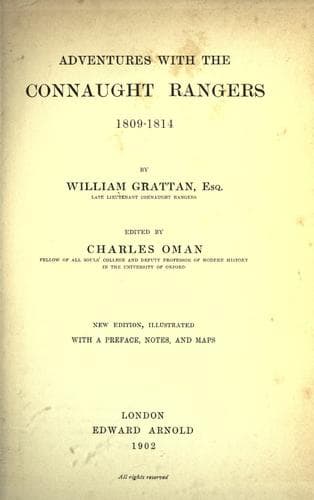
Adventures with the Connaught Rangers, 1809-1814Grattan, William
History
Adventures with the Connaught Rangers, 1809-1814
Grattan, William
Great Britain. Army. Regiment of Foot, 88th (Connaught Rangers); Peninsular War, 1807-1814 -- Personal narratives
There was some irregularity in the arrangement of these troops, and the
Duke of Ragusa essayed in person to remedy the evil. He marched with the
3rd and 4th Divisions to the head of the wood occupied by Boyer, and it
was then he conceived the idea of extending his left, which afterwards
proved so fatal to him. On our side all was arranged for defence; the
bustle which was evident in the ranks of the enemy caused no change in
our dispositions. Lord Wellington, having surveyed what was passing, and
judging that something was meant by it, gave his glass to one of his
aide-de-camps, while he himself sat down to eat a few mouthfuls of cold
beef. He had scarcely commenced when his aide-de-camp said, “The enemy
are in motion, my lord!”—“Very well; observe what they are doing,” was
the reply. A minute or so elapsed, when the aide-de-camp said, “I think
they are extending to their left.”—“The devil they are!” said his
lordship, springing upon his feet,—“give me the glass quickly.” He took
it, and for a short space continued observing the motions of the enemy
with earnest attention. “Come!” he exclaimed, “I think this will do at
last; ride off instantly, and tell Clinton and Leith to return as
rapidly as possible to their former ground.”
In a moment afterwards Lord Wellington was on horseback, and all his
staff in motion. The soldiers stood to their arms—the colours were
uncased—bayonets fixed—the order to prime and load passed, and in five
minutes after the false movement of Marmont was discovered, our army,
which so short a time before stood on the defensive, was arrayed for the
attack! It was twenty minutes past four when these dispositions were
completed; and here it may not be amiss to tell the reader the nature of
the movement made by the French General, which so materially altered his
position, as likewise that of his antagonist—and in doing so I shall be
as brief as I can.
It has been already seen that both armies were so circumstanced as to
almost preclude the possibility of a battle not taking place. Marmont
coveted it—Wellington did not seek to decline it—both had the confidence
of their soldiers—and both, as to numbers, might be said to be on an
equality. When I speak of “numbers” I include the Portuguese troops.
Military men know what was the _real_ value of these soldiers! At two
o’clock in the afternoon Marmont was the aggressor; he held the higher
hand; yet at four, in two short hours afterwards, the relative situation
of both was altogether changed. The natural question will be—How was
this? It occurred just as I am about to describe.
Public-domain text, read in full here on John Shaqi.
Reviews
Reviews
No reviews yet
Be the first to share your thoughts on this work.
Elsewhere in the archive
Join the Discussion
Join the discussion
Sign in to leave a comment or review.
Sign InorCreate an account