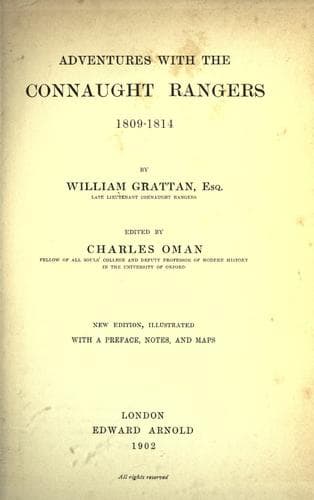
Adventures with the Connaught Rangers, 1809-1814Grattan, William
History
Adventures with the Connaught Rangers, 1809-1814
Grattan, William
Great Britain. Army. Regiment of Foot, 88th (Connaught Rangers); Peninsular War, 1807-1814 -- Personal narratives
The British divisions were scarcely in line when fifty pieces of
artillery crowned the ridge occupied by the French. A heavy fire was
soon opened from this park at half range, and as the 4th and 5th
Divisions advanced they were assailed by a very formidable fire; but as
yet the French infantry, posted behind the ridge, were not visible.
Cole’s troops advanced to the left of the Arapilles height, while Pack,
with his brigade of Portuguese, two thousand strong, pressed onward to
attain it. The 5th Division, under Leith, advanced by the right of
Cole’s troops; and at this moment the French 7th Division were seen
hurrying back to occupy the ground they had so short a time before
quitted, while the 3rd and 4th French Divisions were arranging
themselves to receive the attack of Cole and Leith.
When all was in readiness Pakenham departed at the head of ten
battalions[30] and two brigades of guns, to force the left of the enemy.
Three battalions, the 45th, 74th, and 88th, under Colonel Alexander
Wallace of the 88th, composed the first line; the 9th and 21st
Portuguese of the line, under the Portuguese colonel, De Champlemond,
formed the second line; while two battalions of the 5th, the 77th, 83rd,
and 94th British, under the command of Colonel Campbell, were in
reserve. Such was the disposition of the 3rd Division. In addition,
General D‘Urban, with six Portuguese squadrons, had orders to make head
against Boyer’s dragoons; and that the 3rd Division might not be
molested in its operation, Le Marchant’s three regiments of heavy
cavalry were placed in reserve in the rear of it. It now only remains to
relate what actually happened.
-----
Footnote 30:
It should rather be _twelve_ battalions, as each Portuguese regiment
was composed of two weak battalions.
-----
No sooner was Pakenham in motion towards the heights than the ridge he
was about to assail was crowned with twenty pieces of cannon, while in
the rear of this battery was seen Thomières' division endeavouring to
regain its place in the combat. A flat space, one thousand yards in
breadth, was to be crossed before Pakenham could reach the heights. The
French batteries opened a heavy fire, while our two brigades of
artillery, commanded by Captain Douglas, posted on a rising ground
behind the 3rd Division, replied to them with much warmth. Pakenham’s
men might thus be said to be within two fires—that of their own guns
firing over their heads, while the French balls passed through their
ranks, ploughing up the ground in every direction; but the veteran
troops which composed the 3rd Division were not to be shaken even by
this.
Public-domain text, read in full here on John Shaqi.
Reviews
Reviews
No reviews yet
Be the first to share your thoughts on this work.
Elsewhere in the archive
Join the Discussion
Join the discussion
Sign in to leave a comment or review.
Sign InorCreate an account