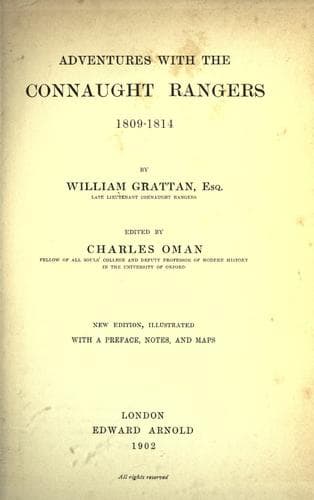
Adventures with the Connaught Rangers, 1809-1814Grattan, William
History
Adventures with the Connaught Rangers, 1809-1814
Grattan, William
Great Britain. Army. Regiment of Foot, 88th (Connaught Rangers); Peninsular War, 1807-1814 -- Personal narratives
Pakenham’s division was already on the left bank of the stream, while
the brigade of nine-pounders, commanded by that admirable officer,
Captain Douglas, opened its fire on the French advance. This, for a
moment, arrested their progress; but O‘Shea, at the head of fifteen
hundred dragoons, passed between the French infantry and the river, and,
disregarding the fire of our artillery, overtook the brigade before it
had passed the ford. The confusion at this point was great; some men
were sabred; but the fire of Douglas’s guns caused the French dragoons
many casualties, and they galloped back to their former ground. The
safety of the brigade which was missing was thus ensured; but Sir Edward
Paget, who had gone in quest of it, and who knew nothing of what had
taken place at the river’s edge, was taken prisoner by O‘Shea. We thus
lost our second in command, as also many men; and the cavalry and
artillery horses had become so enfeebled for want of forage, that it was
manifest our retreat, if vigorously followed by Soult, would, as a
matter of necessity, have been protected by the infantry alone; but
Soult either could not or would not press us, and the remainder of the
day passed over languidly.
CHAPTER XXIV
Sufferings of the army on the retreat—Jokes of the Connaught
Rangers—Letter of Lord Wellington—The junior officers—Costume of the
author during the retreat—An unusual enjoyment.
Notwithstanding the attitude of Pakenham’s troops, and the excellent
arrangement of the park of artillery under Douglas, the troopers of
O‘Shea still menaced the ford. A brigade of French guns ascended the
heights, and opened their fire upon the 3rd Division, but they were
replied to with vigour by Douglas, who on this day surpassed himself;
and the decided superiority which his fire had over that of the enemy
was so palpable that, after a short trial, the French left the heights.
Day was drawing to its close, and our march, as usual, commenced soon
after dark. The entire day had been one of drizzling wet, but, towards
evening, the rain came down in torrents; the army had to march two
leagues ere they reached the point marked out for them on the line of
retreat, and it would be difficult to describe the wretched state of the
troops. The cavalry half dismounted; the artillery without the requisite
number of horses to draw the ammunition-cars, much less the guns; the
infantry without shoes, or nearly so; and the roads, even in the broad
day, nearly impassable, made the march of this night one of great loss.
When a halt occurred, which was often unavoidable in consequence of the
guide mistaking the way, or because of the narrowness of a part of the
road, or the difficulty of ascertaining the pass of a river, those in
the rear fell down asleep, and it was next to impossible to awaken them,
so much were they exhausted; it then became incumbent on every man who
was awake to rouse those in his front, who impeded the line of march,
Public-domain text, read in full here on John Shaqi.
Reviews
Reviews
No reviews yet
Be the first to share your thoughts on this work.
Elsewhere in the archive
Join the Discussion
Join the discussion
Sign in to leave a comment or review.
Sign InorCreate an account