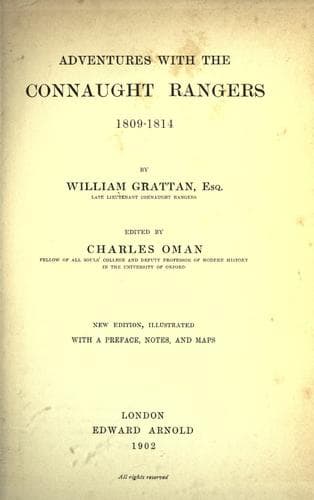
Adventures with the Connaught Rangers, 1809-1814Grattan, William
History
Adventures with the Connaught Rangers, 1809-1814
Grattan, William
Great Britain. Army. Regiment of Foot, 88th (Connaught Rangers); Peninsular War, 1807-1814 -- Personal narratives
There were others, and many others, as badly off as I was. My friend
Meade was obliged to leave his shoes behind him. He tried to walk
barefooted for a while, but it was impossible. The gravel so lacerated
his feet that he could not move, and he was obliged to make some shift
to get a pair in place of those he had abandoned. Captain Graham of the
21st Portuguese, a lieutenant in my regiment, was so worn out with
fatigue, barebacked and barefooted, that, on one night of the retreat,
having been fortunate enough to get a loaf of bread, he joined me and my
companion Meade; but, so unable was he to eat of the food he brought to
share with us, that he fell down on the ground and never tasted a morsel
of it. It is, therefore, tolerably clear to any man possessing common
understanding, that the junior officers of the army, from the neglect of
their superiors, were not in a state to do more than they did.
The retreat still continued, but the army was unmolested, and at length,
after an absence of so many days, we once more got sight of our baggage.
The poor animals that carried it were in a bad state; but they were even
better than our cavalry or artillery horses. Of the former,
three-fourths of the men were dismounted; and the latter could, with
difficulty, show three horses, in place of eight, to a gun.
On this night, I think it was the 26th of November (that is to say, four
weeks, less by two days, since we left Madrid), I enjoyed what I never
expected to see again—a hearty meal. A knot of us got together under a
tent belonging to Captain Robert Nickle, whose batman was one of the
first to arrive with his baggage, and he kept open house for as many as
the tent could accommodate. In the centre was placed a huge pannella of
chocolate, which was garnished by a couple of large loaves of Spanish
bread. The contents of the pannella, as also the dimensions of the
loaves, were soon altered in appearance, and so, indeed, were we. Our
stomachs, which before were as lank as half-starved greyhounds, now
became plump and full, and, moreover, some fragments were left even
after the servants were fed, and abundantly fed.
A dog belonging to Nickle, that had been absent with the baggage, and
which had been on as short rations as his master, also got a bellyful,
and soon after came into the tent, but his owner was so changed in
appearance and dress that the dog did not at first recognise him—which
proves the old adage to be correct that “a man is sometimes so changed
that his own dog don’t know him.”
Public-domain text, read in full here on John Shaqi.
Reviews
Reviews
No reviews yet
Be the first to share your thoughts on this work.
Elsewhere in the archive
Join the Discussion
Join the discussion
Sign in to leave a comment or review.
Sign InorCreate an account