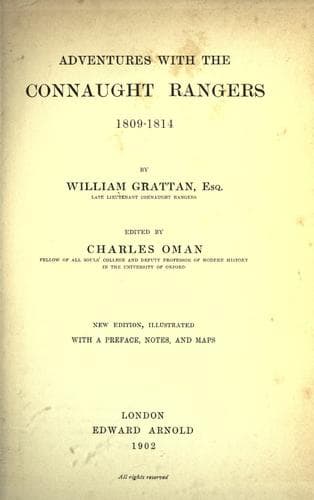
Adventures with the Connaught Rangers, 1809-1814Grattan, William
History
Adventures with the Connaught Rangers, 1809-1814
Grattan, William
Great Britain. Army. Regiment of Foot, 88th (Connaught Rangers); Peninsular War, 1807-1814 -- Personal narratives
Meanwhile D‘Arcy, who conducted his department in the capacity of
Chancellor of the Exchequer, was regular in his attendance at the
gaming-table. He marked with much circumspection the gains and losses of
the numbers on his cards, for and against the banker; but his caution
was of no avail. In the first night’s play one hundred dollars had been
scooped from him by the Portuguese banker, leaving a surplus of about
seventy-five more at his disposal. As this was our last stake, and as
the fleet was to sail the following day (I wish it had sailed ten days
sooner), we all went to San Carlos to witness the luck of D‘Arcy. Before
him lay seventy-five dollars, and before him sat the banker, ready and
willing to relieve him of their weight. For the first half-hour he
played with some success, but afterwards the tide of luck was against
him. Not one of the party interfered _pro_ or _con_. Again he made a
rally, and, like, a ship at sea who has weathered the storm and begins
to right herself, he went on, as it were, sailing before the wind. But,
in a moment of exultation, and having, as he thought, calculated to a
nicety the certainty of success, he staked the entire of our
stock-in-trade on the turn of the card. He was right—the card turned up
in his favour, and he was a winner of three hundred dollars and upwards.
I looked on quietly, and expected to see him take the money or double
the card (which means “double or quit”), thereby insuring his stake at
the worst, or doubling it in the event of success. What, then, was our
astonishment and dismay when we saw him “cock” the card, and heard him,
in a loud tone, addressing the dealer of the pack in the single
monosyllable, “Cock.” Now, the meaning of the word “cock,” and “cocking”
the card, that is to say, turning up one of the corners of it, implies
that you will have, if you gain, three times the stake on the table,
but, if you lose, you lose all. So it was with D‘Arcy; the wrong card
turned up, and we, one and all, turned out, went home to our beds,
sailed for Portsmouth next day, and I never wagered a shilling at a
gaming-table since. Perhaps it was the best “turn up” I ever had.
Public-domain text, read in full here on John Shaqi.
Reviews
Reviews
No reviews yet
Be the first to share your thoughts on this work.
Elsewhere in the archive
Join the Discussion
Join the discussion
Sign in to leave a comment or review.
Sign InorCreate an account