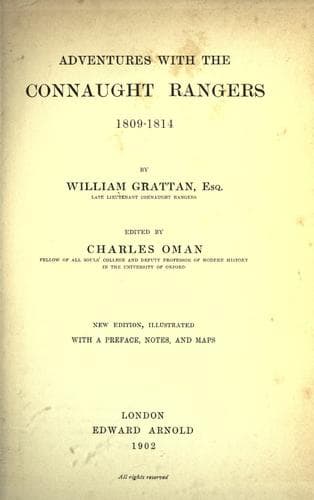
Adventures with the Connaught Rangers, 1809-1814Grattan, William
History
Adventures with the Connaught Rangers, 1809-1814
Grattan, William
Great Britain. Army. Regiment of Foot, 88th (Connaught Rangers); Peninsular War, 1807-1814 -- Personal narratives
His wish was soon gratified, for when his regiment, at Busaco, was
running headlong with the bayonet against three of Reynier’s splendid
battalions, Thorp, to the amazement of Colonel Wallace, was seen at the
head of the 88th, not with his “mace of office” in his hand, but with
his plumed hat, waving it high over his head, as he called out, “The
Connaught Rangers for ever!” During the action the Sergeant-Major had
been killed while fighting beside Thorp, and Wallace, on the field of
battle, named him as Sergeant-Major, in place of the one he had lost.
From this period up to the battle of Toulouse, Thorp was a distinguished
man. Four times had he been wounded, but he was always up with his
regiment in time for the next battle, often with his wounds unhealed. At
the battle of Orthes, his conduct was so remarkable that his name was
forwarded for an ensigncy. Thorp knew this, and at Toulouse, the last
battle fought by the Peninsular army, he was resolved to prove that his
recommendation was deserved. In this action his bravery was not bravery
alone—it was rashness.
Some companies of Picton’s division had been repulsed in an attack at
the bridge-head, near the canal—which attack it has been said, and in my
opinion truly said, should never have been made—when Thorp ran forward,
and assisted in rallying the soldiers. The fire from the firearms and
batteries of the French was incessant, and many officers and soldiers
had fallen. There was one spot in particular that had been the scene of
much slaughter to those who occupied it, and five officers, besides
numbers of soldiers, had been already struck down by cannon-shot, and
others wounded by musketry. Amongst the latter was Captain Robert
Nickle, one of the most distinguished officers in the army. While he was
hobbling to the rear, he observed Thorp standing in the midst of those
who had fallen, the rest having been withdrawn out of fire from a
position that should never have been occupied. For in the front of the
French battery, and running in a direct line from the canal to this
position, was a low narrow avenue or hedge, which ended within a few
yards of where our people had formed after their repulse, and this
avenue served as a guide, or groove, for the enemy’s range; they were
now, however, more or less, under cover. In a moment of excitement,
Thorp, with his cap in his hand, stood alone on this spot, saying, “Now
let us see if they can hit _me_!” Nickle, who was passing at the moment,
supported by two of his company—for his arm was badly shattered—called
out to Thorp to leave the spot. “Oh, Captain Nickle,” replied Thorp,
“they can’t hit _me_, I think.” Those were the last words he ever
uttered. A round shot struck his chest, and, cutting him in two, whirled
his remains in the air. Thus fell the gallant Thorp, and though his rank
was humble, his chivalrous deeds were those of a hero. The day after his
death the English mail brought the _Gazette_ in which poor Thorp’s name
Public-domain text, read in full here on John Shaqi.
Reviews
Reviews
No reviews yet
Be the first to share your thoughts on this work.
Elsewhere in the archive
Join the Discussion
Join the discussion
Sign in to leave a comment or review.
Sign InorCreate an account